The short answer
Tattoos fade faster when the ink is easy for the laser to target and easy for your body to clear away. Black ink, older tattoos, thinly applied amateur ink and locations with good blood supply — such as the upper body — tend to respond quickest. Dense, deep, brightly coloured or recently applied tattoos, and those on the hands or feet, are slower. Your skin, health and lifestyle also play a part.
Two people can have similar-looking tattoos and yet one clears in a handful of sessions while the other barely shifts. The difference comes down to how easily the laser can break up the ink and how efficiently the immune system can carry the fragments away. This page explains the factors that speed up — or slow down — the fading process.
Fading speed at a glance
- Fastest ink Black and dark blue
- Slowest ink Green, light blue, yellow
- Faster locations Upper body, good blood supply
- Slower locations Hands, fingers, ankles, feet
- Helps clearance Healthy immune system, not smoking
It comes down to targeting and clearance
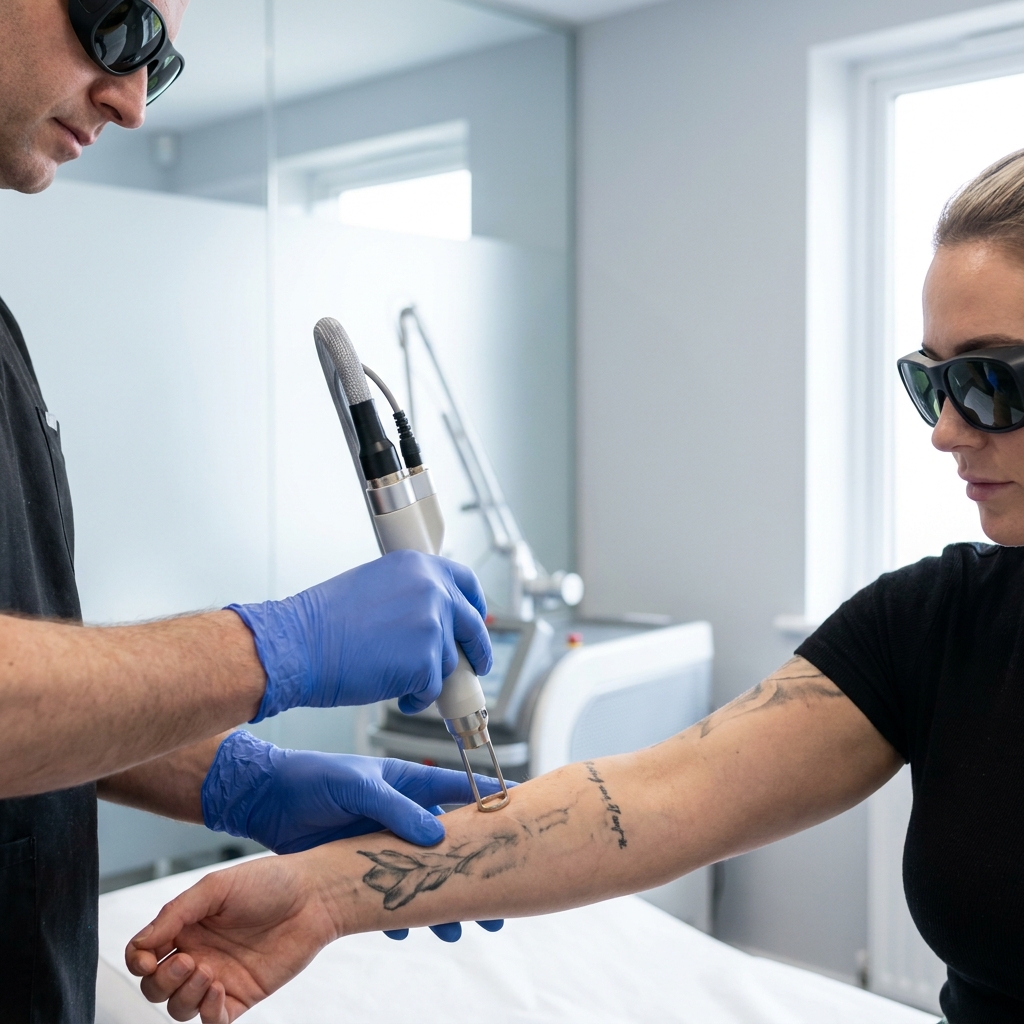
Laser removal has two stages: the laser must first fragment the ink, then your body must clear it. A tattoo fades quickly when both stages go smoothly — the laser energy is well absorbed by the pigment, and the lymphatic system efficiently removes the broken-down particles. Anything that hinders either stage slows the result. So when people ask why one tattoo fades faster than another, the answer is always some combination of “the laser couldn’t target this ink as well” or “this person’s body clears pigment more slowly here”. The underlying process is covered in how lasers break down ink.
Ink colour, depth and density
Colour is the biggest single factor. Black ink absorbs every laser wavelength, so it shatters readily and fades fastest. Coloured inks only absorb specific wavelengths, and some — green, light blue and yellow — are stubborn and may need more sessions or never fully clear. If your tattoo is mostly black, you can usually expect quicker, more predictable fading; if it is a busy mix of colours, expect a longer course. The detail is on black vs coloured tattoo removal.
Depth and density matter too. A tattoo applied lightly, with ink sitting higher in the skin, fades faster than one packed densely or driven deep. Heavily saturated areas of solid colour or thick black shading hold more pigment and so take longer than fine linework. This is one reason amateur tattoos often respond more quickly than heavy professional work — explored on amateur vs professional tattoo removal.
Age plays into this as well. Older tattoos have usually started to fade naturally as the body slowly clears pigment over the years. That head start means an older tattoo often needs fewer sessions than a fresh one, where the ink is dense and fully intact. It is a common surprise that the faded old tattoo someone has lived with for twenty years can lift more easily than a crisp piece from last year. The comparison is set out on old vs new tattoo removal.
| Factor | Faster fade | Slower fade |
|---|---|---|
| Ink colour | Black, dark blue | Green, light blue, yellow |
| Ink density | Light, single-layer | Dense, multi-layered |
| Tattoo age | Older, already faded | Recent, fully intact |
| Location | Chest, back, upper arm | Hands, fingers, ankles, feet |
Where the tattoo sits on the body
Location changes the speed of clearance because it changes blood supply. Areas close to the heart with rich circulation — the chest, back and upper arms — clear pigment faster. The extremities, especially the hands, fingers, ankles and feet, have poorer circulation and are slower, often needing extra sessions. This is one of the main reasons a small tattoo on the ankle can take longer than a larger one on the shoulder, which surprises people who assume size alone decides the timeline.
Your skin, health and lifestyle
The fade also depends on you. A well-functioning immune and lymphatic system clears fragmented ink more efficiently, so your general health plays a genuine role in the result. The factors that tend to help or hinder include:
- General health — a healthy immune system clears pigment more effectively.
- Smoking — can slow circulation and is linked to slower clearance.
- Hydration and activity — supporting good circulation may help the process.
- Skin tone — influences the laser settings used, which can affect how aggressively a tattoo is treated; see tattoo removal on different skin tones.
What this means for you
You cannot change your tattoo’s colour, depth, age or location, but understanding these factors helps you set realistic expectations and avoid disappointment if your tattoo is on the slower end. It also helps you spot an over-promising clinic: a practitioner who insists every tattoo clears in a fixed handful of sessions is ignoring the biology. Because so many variables combine, the only reliable way to predict how quickly your tattoo will fade is a consultation and patch test with a qualified practitioner. This page is general information, not medical advice; individual results vary.
Frequently asked questions
Why does my friend’s tattoo fade faster than mine?
Likely a mix of ink colour, density and age, plus where each tattoo sits on the body. Black, older and lightly applied ink on a well-circulated area fades fastest.
Does drinking water make tattoos fade faster?
Staying well hydrated supports good circulation, which helps your body clear fragmented ink, but it is not a shortcut. The pace is mostly set by the ink and your physiology.
Will exercise speed up my removal?
Good circulation may support clearance, but there is no guarantee exercise speeds results. Follow your practitioner’s aftercare advice and avoid anything that irritates healing skin.
Can a clinic make a slow tattoo fade faster?
A practitioner can optimise the laser and settings, but they cannot override the biology. Stubborn colours or poorly circulated areas simply take more sessions, and some shadow may remain.
Sources & further reading
- NHS — Laser and intense pulsed light (IPL) treatments
- NHS — Cosmetic procedures: things to consider before you go ahead
- MHRA — Lasers, intense light source systems and LEDs: guidance
- British Medical Laser Association (BMLA) — laser treatment information
This guide is general information, not medical advice. A patch test and consultation with a qualified, regulated practitioner are essential before treatment, and results vary by individual. Discuss any skin or health concerns with the practitioner or your GP.