The short answer
Laser tattoo removal works by firing very short, high-energy pulses of light into the skin. The ink absorbs that light and shatters into tiny fragments. Your immune system then carries those fragments away over the following weeks. Because each pass only breaks down part of the ink, a full course typically needs 6–12 sessions spaced 6–8 weeks apart. Black ink responds best; some colours are harder, and complete removal cannot be guaranteed.
Laser removal is the established way to fade or clear an unwanted tattoo in the UK. It is not a single treatment but a course, and understanding the mechanism — light, heat, fragmentation and immune clearance — explains why it takes months, why colour matters and why a consultation and patch test always come first.
Laser tattoo removal at a glance
- Method Pulsed laser light absorbed by ink
- Sessions Typically 6–12, sometimes more
- Spacing Every 6–8 weeks
- Cost per session Roughly £50–£200
- Best response Black ink
- Guarantee Complete removal cannot be promised
The basic principle: light becomes heat
A tattoo sits in the dermis, the second layer of skin, where ink particles are too large for your body to remove on its own. That is precisely why a tattoo is permanent: the immune system simply cannot shift particles of that size. Laser removal changes the equation by delivering an enormous burst of energy in an extremely short space of time. The pigment absorbs the laser light, heats up violently and breaks apart. This process is called photothermal and photomechanical fragmentation, and it is the foundation of every modern removal device. You can read more about the underlying physics in our guide to how lasers break down ink.
Crucially, the laser is tuned so that the ink absorbs the energy far more strongly than the surrounding skin. A well-chosen wavelength and a very short pulse mean the pigment shatters while the skin around it is comparatively spared. This selectivity — known as selective photothermolysis — is what makes laser removal possible without destroying the whole area of skin, though some reaction in the surrounding tissue is normal and expected. It also explains why the laser cannot be turned up indefinitely: push the energy too high and the skin, not just the ink, takes the damage.
Why it takes many sessions
A single treatment only fractures a portion of the ink. After each session your immune system — chiefly white blood cells called macrophages — gradually engulfs and transports the shattered fragments to the lymphatic system, where they are processed and cleared. This clearance is slow and biological, not instant, which is why sessions are spaced several weeks apart rather than days. Rushing the gaps does not speed up removal and can increase the risk of skin reactions, because the skin has not finished healing from the previous pass.
- Session count: most tattoos need 6–12 sessions, and stubborn or densely packed ink can need more.
- Spacing: usually 6–8 weeks, allowing pigment to clear and skin to fully recover between visits.
- Gradual fading: the tattoo lightens step by step rather than vanishing in one go.
- Cumulative effect: each session builds on the last, with the deepest ink often the last to clear.
The number of sessions is an estimate, not a fixed figure. A qualified practitioner can give a more realistic course length at a consultation, but every individual responds differently, and the count can rise if the ink proves stubborn. Skipping or rushing appointments does not shorten the overall journey and can leave the skin too little time to recover.
What affects how well it works
Several factors decide how completely a tattoo can be removed and how long it takes. Black ink absorbs the widest range of wavelengths and clears most reliably; greens, light blues and yellows are far harder and sometimes resist even a long course. The age, depth, density and layering of the ink matter too, as does your skin tone, immune health and whether you smoke, which can slow clearance by reducing circulation.
| Factor | Effect on removal |
|---|---|
| Ink colour | Black easiest; green, light blue, yellow hardest |
| Ink depth & density | Deep, heavily layered ink needs more sessions |
| Tattoo age | Older, faded tattoos often clear faster |
| Skin tone | Affects safe settings and risk of pigment change |
| Lifestyle | Good circulation and not smoking aid clearance |
For a fuller picture of these variables, see the factors that affect tattoo removal. Because so many variables interact, two people with apparently similar tattoos can have quite different experiences, which is why no honest practitioner promises a fixed outcome and why every plan is individual.
What a session involves
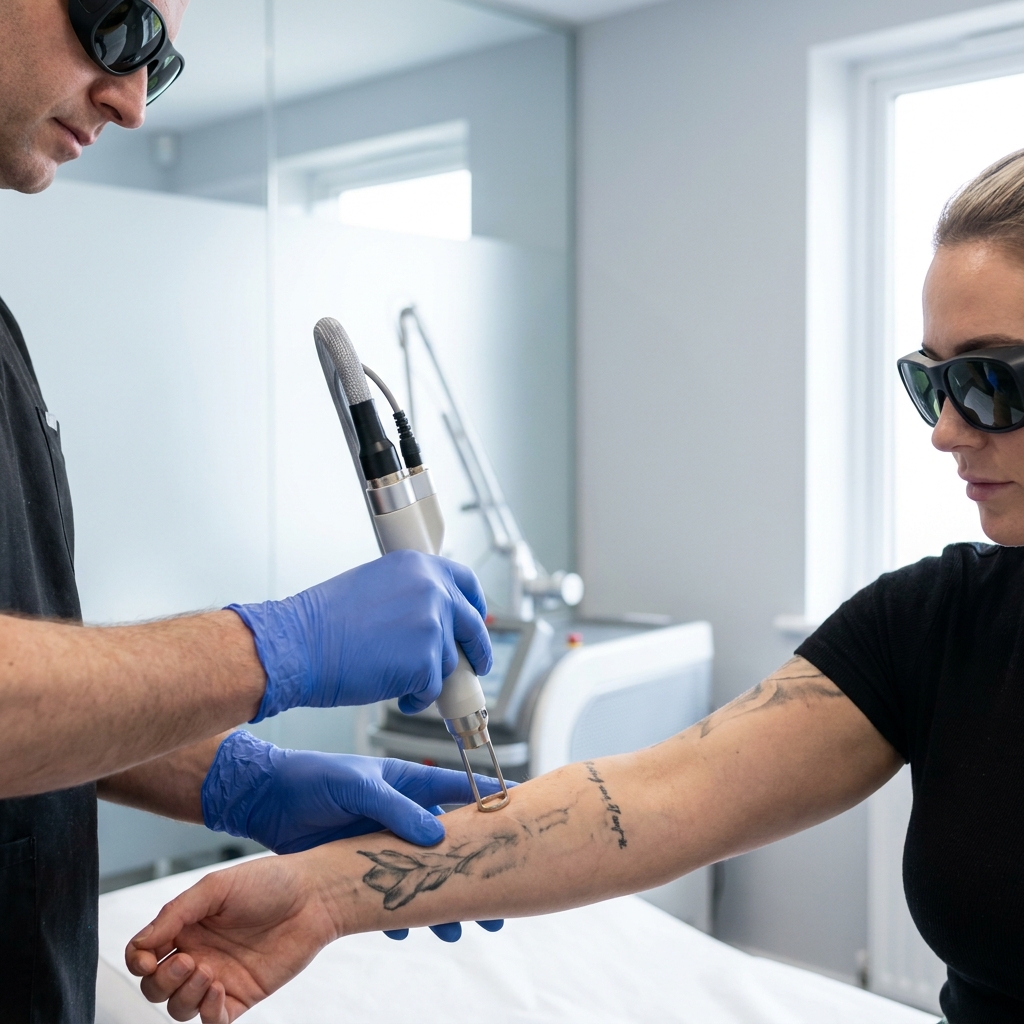
On the day, the practitioner cleans the area, you both wear protective eyewear, and the handheld laser is passed methodically across the tattoo. Each pulse feels like an elastic band snapping against the skin, and a temporary white “frosting” may appear as the ink reacts. A small tattoo takes only a minute or two of actual lasering, while larger pieces take a little longer. Afterwards the area is cooled and dressed, and you are given aftercare advice — keeping it clean, not picking scabs and protecting it from the sun. The full step-by-step is covered in laser tattoo removal explained, and discomfort is eased with cooling or numbing cream where needed.
The laser technology used
Two families of laser dominate. Q-switched lasers fire in nanoseconds (billionths of a second) and have been the workhorse for decades. Newer picosecond lasers fire even faster, in trillionths of a second, and can shatter pigment into finer fragments — we compare them in picosecond versus nanosecond lasers. In the UK these devices are regulated as part of the wider framework overseen by the MHRA, and the clinic environment is subject to the relevant national regulator — HIS in Scotland, HIW in Wales, the RQIA in Northern Ireland, and CQC registration where a service is doctor-led in England. Always check that your practitioner is properly trained and that the clinic is regulated for the nation you are in.
What to expect overall
From start to finish a course of removal commonly spans a year or more once you account for the spacing between sessions and the time the body needs to clear pigment. Cost is spread across that course, typically roughly £50–£200 per session depending on the tattoo’s size, with a small tattoo often totalling £200–£600 and larger pieces £1,000 or more. The experience involves some discomfort during each pass, a healing period afterwards and gradual, cumulative fading. If you are weighing it up, our guides on whether tattoo removal works and removal versus cover-up set out the realistic options. This page is general information and not medical advice; speak to a qualified practitioner about your own skin and tattoo, and remember that results vary by individual.
Frequently asked questions
How long does the whole process take?
Because sessions are spaced 6–8 weeks apart and most tattoos need 6–12 of them, a full course commonly runs a year or longer. Your practitioner can give a personal estimate, but timelines vary by individual.
Does the laser remove the ink immediately?
No. The laser shatters the ink into tiny fragments; your immune system then clears those fragments over the following weeks. The fading is gradual and cumulative rather than instant.
Why can’t every tattoo be fully removed?
Some ink colours absorb laser light poorly, and dense, deep or layered ink can resist treatment. Skin tone and individual healing also play a part, so complete removal can never be guaranteed.
Is laser removal safe?
When carried out by a trained practitioner at a regulated clinic, with a patch test and proper aftercare, it is widely used. There are risks such as blistering and pigment change, so a consultation is essential.
Sources & further reading
- NHS — Cosmetic procedures: laser and light treatments
- MHRA — Regulation of lasers and intense pulsed light (IPL) devices
- JCCP — Joint Council for Cosmetic Practitioners register
- British Medical Laser Association (BMLA) — laser safety guidance
This guide is general information, not medical advice. A patch test and consultation with a qualified, regulated practitioner are essential before treatment, and results vary by individual. Discuss any skin or health concerns with the practitioner or your GP.