The short answer
Choose a clinic on competence and safety, not price. Look for a practitioner with recognised laser training, professional indemnity insurance, and registration with the JCCP voluntary register where possible. Insist on a face-to-face consultation and a patch test before any full treatment. Check whether the clinic is registered with the relevant regulator for your UK nation, and be wary of anyone who guarantees complete removal or skips assessment. Results vary, and this is general information, not medical advice.
Laser tattoo removal is a medical-grade procedure that fires high-energy light into your skin, so the person holding the device matters far more than the décor of the room. This guide sets out the concrete things to check — training, regulation, insurance and process — so you can tell a careful clinic from a corner-cutting one.
Choosing a clinic at a glance
- First priority Practitioner competence, not lowest price
- Essential step Face-to-face consultation
- Before treatment A patch test on your skin
- Look for JCCP registration & laser training
- Must have Professional indemnity insurance
- Red flag Any guarantee of complete removal
Why the clinic choice matters so much
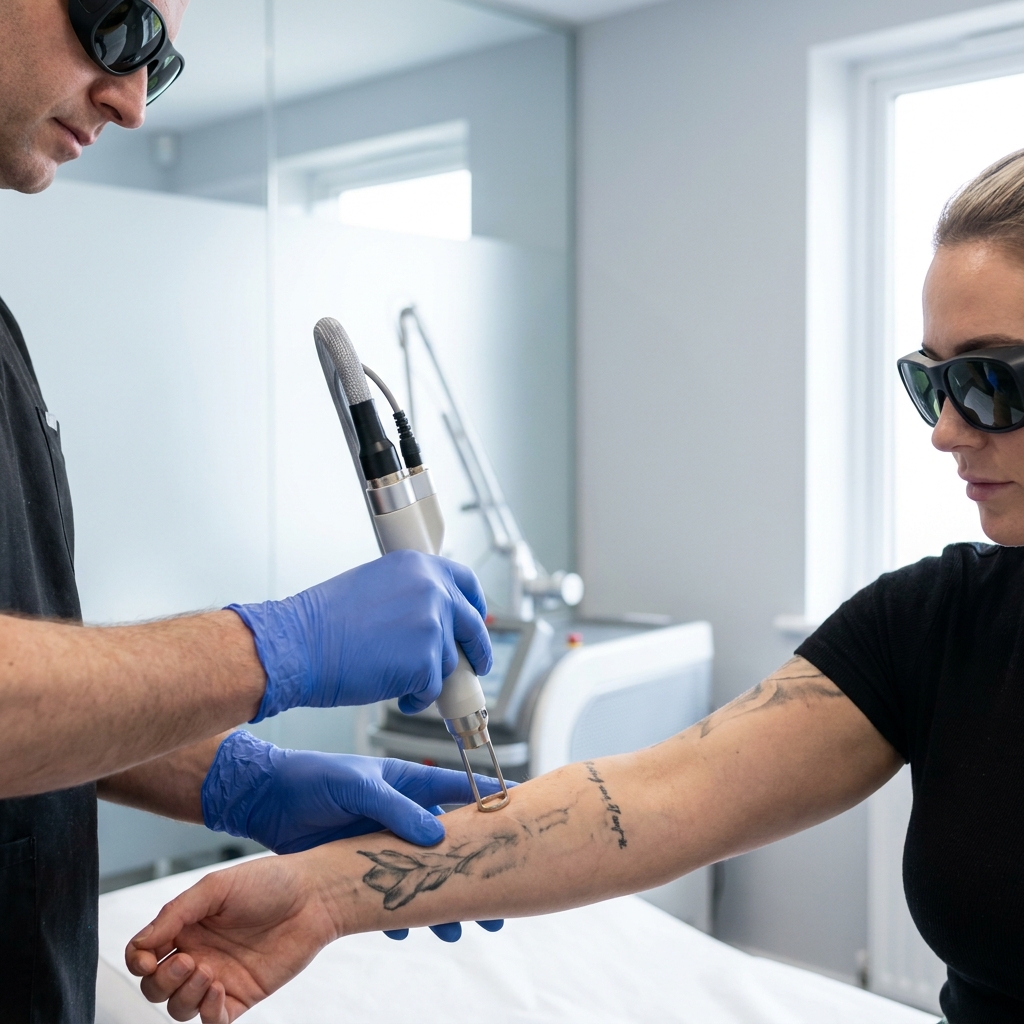
Laser tattoo removal uses a Q-switched or picosecond laser that delivers extremely short, high-energy pulses to shatter ink particles beneath the skin. In the wrong hands that same energy can cause burns, blistering, pigment changes and scarring. Unlike choosing a hairdresser, the stakes are clinical: you are trusting someone to treat your skin safely, judge your suitability, and respond correctly if a reaction occurs. That is why the decision should rest on the practitioner’s training and the clinic’s safety standards rather than on a flashy website or the cheapest per-session price. A good clinic will welcome your questions; a poor one will rush you toward a deposit. Understanding how tattoo removal works first helps you judge whether the advice you are given is honest.
Training and qualifications to look for
There is no single mandatory national qualification for a laser tattoo removal practitioner in England, which makes verifying training your responsibility. Ask directly what laser-specific training the practitioner has completed, how long they have been operating that particular machine, and whether they hold a recognised Level 4 laser and light qualification or equivalent. Membership of a body such as the British Medical Laser Association (BMLA) or registration on the Joint Council for Cosmetic Practitioners (JCCP) voluntary register are strong positive signals, because both expect evidence of training and standards. You can read more about verifying this in is my tattoo removalist qualified.
- Laser-specific training — not just a general beauty qualification.
- Core of knowledge — laser-safety training expected of operators.
- JCCP register — a voluntary public register of practitioners.
- Insurance — professional indemnity cover specifically for laser work.
Regulation, registration and insurance
Whether a clinic must be registered depends on where you live and who performs the procedure. In much of England, cosmetic laser is not regulated nationally, though many local authorities licence “special treatments”; in Scotland independent clinics are regulated by Healthcare Improvement Scotland, in Wales by Healthcare Inspectorate Wales, and in Northern Ireland by the RQIA. Where a doctor or nurse leads a medical procedure, the Care Quality Commission may be involved in England. Ask the clinic which regulator it answers to and whether it holds a local-authority licence. Our page on laser tattoo removal regulation in the UK explains the position by nation in detail.
| Check | What good looks like | Why it matters |
|---|---|---|
| Consultation | Free, unhurried, face-to-face | Assesses suitability and sets expectations |
| Patch test | Done before any full session | Reveals adverse skin reactions early |
| Insurance | Laser-specific indemnity cover | Protects you if something goes wrong |
| Hygiene | Clean room, single-use items | Reduces infection risk |
Red flags to walk away from
Some warning signs are clear enough to end the conversation. Be cautious of any clinic that promises complete removal in a fixed number of sessions, since outcomes genuinely vary by ink, colour, age of the tattoo and your skin. Walk away if there is no patch test, no proper consultation, pressure to pay a large upfront block before you have seen the practitioner, or vague answers about training and insurance. A practitioner who cannot tell you which laser they use, or who dismisses questions about side effects, is telling you something important.
What to do next
Once you have shortlisted clinics that pass these checks, book consultations at two or three before committing. Compare not just price but how thoroughly each assesses you, whether they insist on a patch test, and how clearly they explain the likely number of sessions and the aftercare. A careful, qualified clinic will set realistic expectations and treat your safety as the priority. When you are ready, our guide on how to find a tattoo removal clinic walks through where to look and the final questions to ask.
Frequently asked questions
Should I choose the cheapest tattoo removal clinic?
No. Price should come after safety and competence. A very low price can mean an undertrained operator or a cheaper, less effective machine. Compare consultations, training and insurance first.
Is a consultation always necessary?
Yes. A proper face-to-face consultation assesses your skin, your tattoo and your suitability, and lets the clinic plan a safe course. Avoid any clinic that skips it.
How do I know a clinic is regulated?
Ask which regulator it answers to. This depends on your UK nation — HIS in Scotland, HIW in Wales, RQIA in Northern Ireland, and local-authority licensing or the CQC in England where doctor-led.
What if a clinic guarantees full removal?
Treat it as a red flag. Complete removal cannot be guaranteed for anyone, because results depend on the ink, colour, age and your skin. Honest clinics describe likely ranges, not certainties.
Sources & further reading
- NHS — Laser and IPL treatments and cosmetic procedures
- JCCP — Joint Council for Cosmetic Practitioners voluntary register
- MHRA — Regulation of lasers and intense light source devices
- British Medical Laser Association (BMLA) — standards for practitioners
This guide is general information, not medical advice. A patch test and consultation with a qualified, regulated practitioner are essential before treatment, and results vary by individual. Discuss any skin or health concerns with the practitioner or your GP.