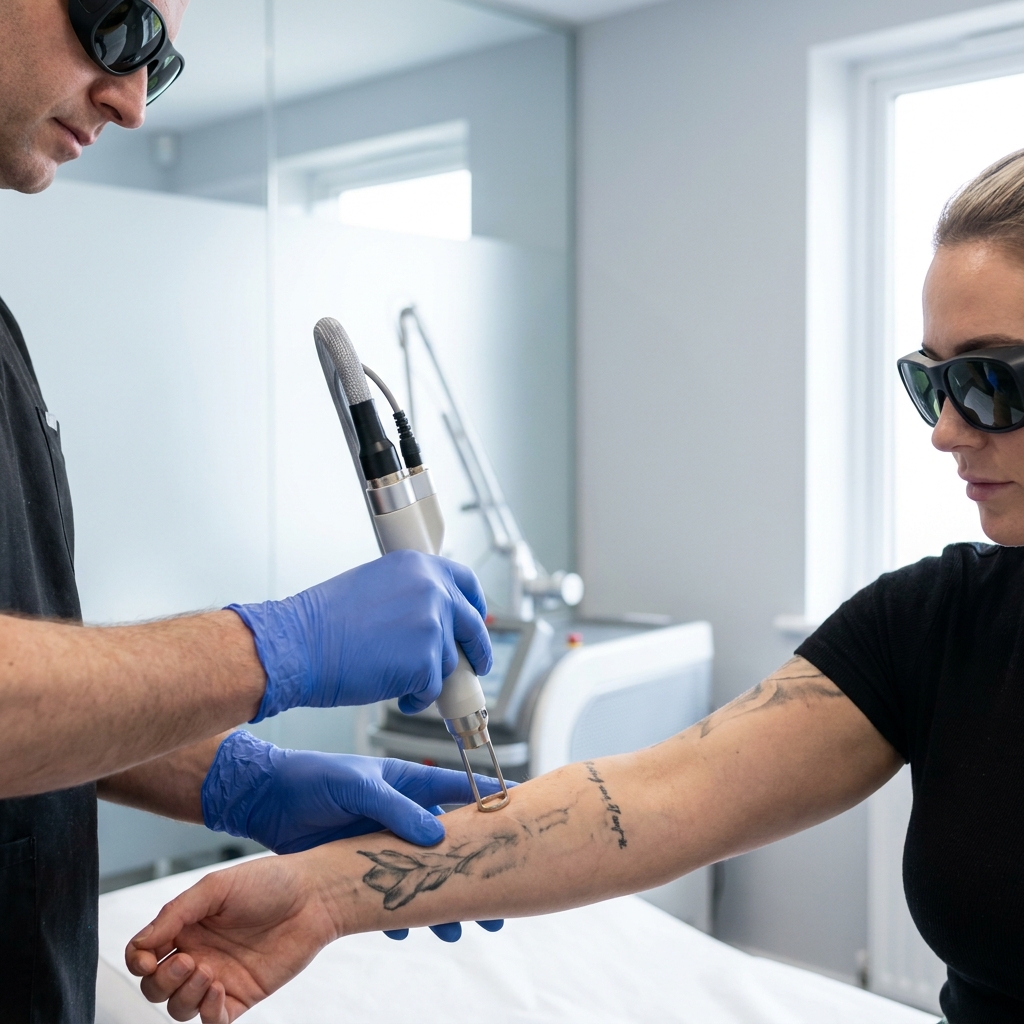
The short answer
Amateur tattoos often remove faster because the ink is usually applied more shallowly and less densely than professional work. Less ink, sitting higher in the skin, is easier for the laser to reach and the body to clear. However, amateur ink can be uneven in depth and the pigments unknown, which makes results less predictable. Professional tattoos are denser and deeper, so they typically need more sessions.
A teenage stick-and-poke and a professional sleeve are very different propositions for a laser. How the ink was applied — how deep, how dense, and what pigment was used — strongly affects how easily it clears. This page compares amateur and professional tattoos and explains why homemade ink can be both quicker to fade and harder to predict.
Amateur vs professional at a glance
- Amateur ink Often shallower, less dense
- Professional ink Deeper, denser, even
- Amateur sessions Often fewer
- Professional sessions Usually more
- Amateur catch Unpredictable depth and pigment
Why how a tattoo was made matters
Two things decide how easily a tattoo clears: how much ink there is and how deep it sits. Professional tattooists use a machine to drive a consistent, dense layer of pigment into the dermis at a controlled depth. Amateur tattoos — hand-poked “stick-and-poke” pieces, prison tattoos or ones done with basic equipment — usually deposit less ink, often more shallowly, and less evenly. Shallower, sparser ink is easier for the laser to fragment and for the body to clear, which is why amateur work frequently needs fewer sessions than a comparable professional tattoo. The clearance principle is on how tattoo removal works.
Where amateur tattoos are unpredictable
The flip side is inconsistency. Because amateur application is uneven, parts of a homemade tattoo may sit deep while others are shallow, so it can fade patchily — some areas lifting quickly while others lag. The pigments used are also often unknown — sometimes ordinary pen ink, soot or substances never designed for tattooing — which makes the response harder to predict and reinforces the need for a patch test first. An unknown pigment may react in unexpected ways, so a practitioner cannot promise how it will behave until it has been tested. See tattoo removal patch test.
| Amateur tattoo | Professional tattoo | |
|---|---|---|
| Ink depth | Often shallow, uneven | Deeper, consistent |
| Ink density | Usually lighter | Dense, layered |
| Typical sessions | Often fewer | Usually more |
| Predictability | Less predictable | More predictable |
| Pigment known? | Often not | Usually standard inks |
Professional tattoos: denser but predictable
Professional work is harder simply because there is more ink, placed deeper and more evenly. That means more sessions, but the even, controlled application tends to fade more uniformly and predictably, so a practitioner can estimate the course with more confidence. Colour still matters as much as application — a professional black tattoo may clear faster than a colourful amateur one — so this comparison sits alongside black vs coloured tattoo removal and factors affecting tattoo removal.
- Amateur, single-colour, shallow — often among the quickest to fade.
- Amateur, uneven depth — can fade patchily; harder to predict.
- Professional black — predictable, but denser, so more sessions.
- Professional multicolour — the most sessions, needing the right wavelengths.
A note on scarring under the tattoo
Amateur tattoos are sometimes applied with poor technique that has already left some scarring in the skin beneath the ink. Laser removal clears pigment but does not remove pre-existing scarring, so once the ink fades, any scar tissue that was already there may become more visible. A practitioner should assess for this at consultation and explain what the skin is likely to look like afterwards, so there are no surprises. This is another reason an in-person assessment matters more for amateur work.
What to do next
Whether your tattoo is amateur or professional, the route is the same: a consultation and patch test with a qualified practitioner, who can assess the ink’s depth, density and likely pigment and estimate a realistic course. Choosing a properly qualified clinic matters even more with unknown amateur ink, because the practitioner’s judgement about how an uncertain pigment will behave is part of what you are paying for — see choosing a clinic. Do not be discouraged if your tattoo is homemade: many amateur pieces are among the more straightforward to fade, and a good practitioner will give you an honest, realistic plan after seeing it in person. This page is general information, not medical advice; individual results vary.
Frequently asked questions
Do homemade tattoos come off easier?
Often, yes, because amateur ink tends to be shallower and less dense, so the laser reaches it more easily. But uneven depth and unknown pigments can make the result less predictable.
Why do professional tattoos need more sessions?
They contain more ink, applied deeper and more densely than amateur work, so there is more pigment for the laser to fragment and the body to clear.
Are amateur tattoo pigments harder to remove?
Sometimes. Amateur inks may not be standard tattoo pigments and can react unpredictably, which is why a patch test is especially important before treatment.
Will an amateur tattoo fade evenly?
Not always. Because amateur application varies in depth, a homemade tattoo can fade patchily, with some areas clearing faster than others.
Sources & further reading
- NHS — Laser and intense pulsed light (IPL) treatments
- NHS — Tattoos: looking after a tattoo and possible problems
- MHRA — Lasers, intense light source systems and LEDs: guidance
- NHS — Cosmetic procedures: things to consider before you go ahead
This guide is general information, not medical advice. A patch test and consultation with a qualified, regulated practitioner are essential before treatment, and results vary by individual. Discuss any skin or health concerns with the practitioner or your GP.