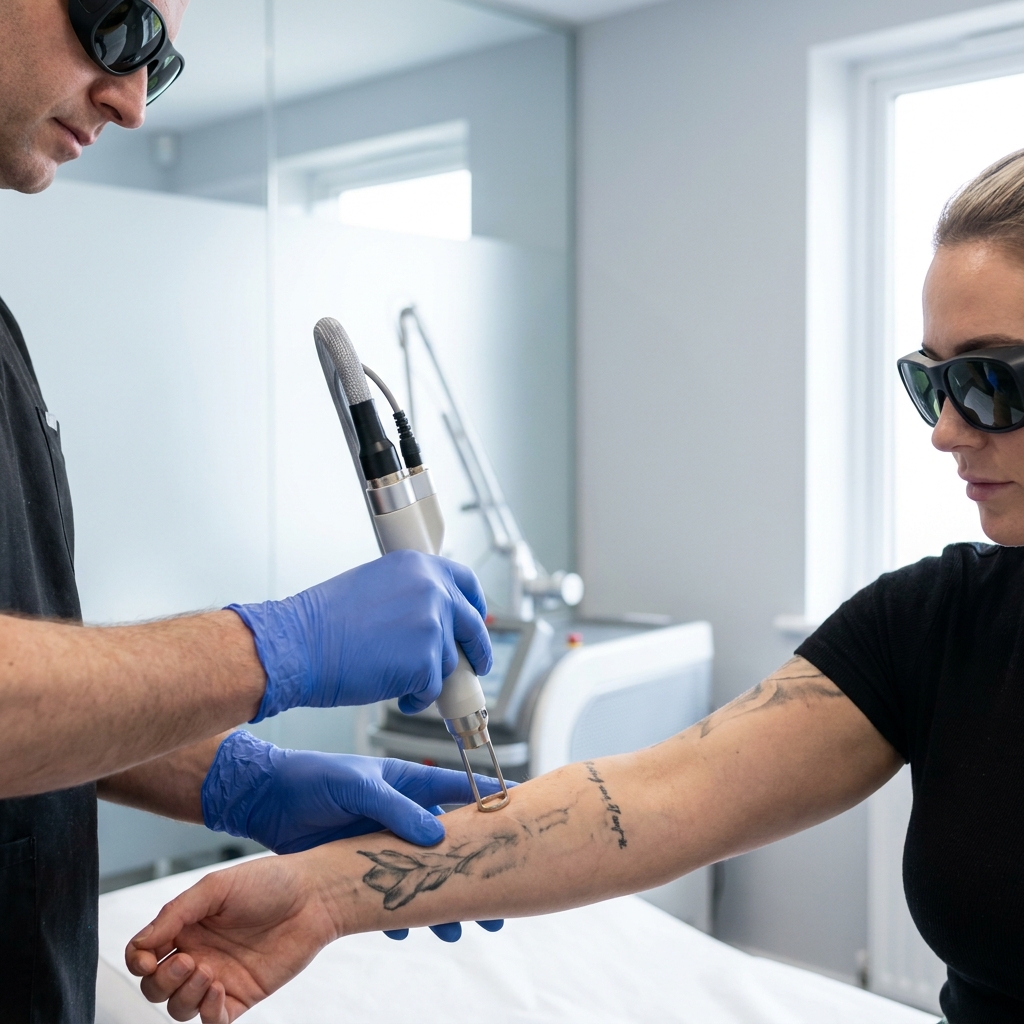
The short answer
A laser breaks down tattoo ink by delivering energy so fast that the pigment shatters before it can pass heat to the surrounding skin. The ink absorbs a specific wavelength of light, heats instantly and fractures into tiny fragments through a shockwave effect. Your immune system — mainly macrophages — then carries those fragments to the lymphatic system to be cleared. This is why removal is gradual and needs a course of sessions.
To understand removal, it helps to understand the physics. The reason a laser can clear ink that has been permanent for years comes down to a principle called selective photothermolysis: targeting the pigment precisely, at the right wavelength, in an instant. This page explains the science in plain terms.
The science at a glance
- Principle Selective photothermolysis
- Target Tattoo ink in the dermis
- Effect Shockwave shatters pigment
- Clearance Macrophages & lymphatic system
- Wavelength Matched to ink colour
- Why gradual Body clears fragments over weeks
Selective photothermolysis
The guiding principle of laser removal is selective photothermolysis: using a wavelength of light that the ink absorbs strongly but the surrounding skin largely does not. When the pigment soaks up that energy far more than the tissue around it, the laser can damage the ink while sparing most of the skin. The word breaks down neatly — “photo” (light), “thermo” (heat) and “lysis” (breaking apart) — and it is the same principle that underpins many medical laser treatments. Different ink colours absorb different wavelengths, which is why a clinic may use several different lasers or settings, explored further in tattoo ink colours and removal.
Speed is everything
The pulse is extraordinarily short — billionths or trillionths of a second — and that speed is the whole point. Energy delivered that quickly does not have time to spread as heat into nearby skin. Instead it builds up inside the ink particle so rapidly that the particle effectively explodes, fracturing into tiny fragments through a photomechanical shockwave. A longer, slower pulse would heat a wider area and risk burning the skin without cleanly shattering the pigment. This is why pulse duration distinguishes the main laser types, compared in picosecond versus nanosecond lasers: the shorter the pulse, the more the effect favours shattering over heating.
- Absorption: the ink absorbs the matched wavelength of light.
- Heating: the particle heats almost instantly.
- Fragmentation: a shockwave shatters it into smaller pieces.
- Clearance: the immune system removes the debris over weeks.
How the body clears the fragments
Shattering the ink is only half the job. Once a particle is small enough, immune cells called macrophages engulf the fragments and carry them away, draining through the lymphatic system to be processed and excreted. This biological clearance is slow, which is why visible fading lags behind each treatment and why sessions are spaced 6–8 weeks apart — the body needs time to do its work. The overall journey is covered in how tattoo removal works.
| Stage | What happens | Timescale |
|---|---|---|
| Pulse | Ink absorbs light, shatters | Instant |
| Inflammation | Skin reacts, may blister | Days |
| Clearance | Macrophages remove fragments | Weeks |
| Fading | Tattoo visibly lightens | Across the course |
Why colour and depth change the result
Because each colour needs its own wavelength, a tattoo with several colours is harder to treat fully — black absorbs broadly and clears well, while green, light blue and yellow are stubborn. Deep or densely packed ink means more particles for the body to clear, lengthening the course. Skin tone also limits the safe settings, since the laser must avoid over-targeting the skin’s own pigment — see removal on different skin tones.
Why settings must be tailored
All of this is why a removal laser cannot simply be set to maximum power. The practitioner balances enough energy to fragment the ink against the need to protect the skin, choosing the wavelength for the colour and the energy for the skin tone. Get it wrong and you risk burns, blistering or lasting pigment change; get it right and the ink fragments while the skin recovers. This balance is also why a patch test comes first and why the operator’s training matters as much as the machine.
The practical takeaway
The science explains the practicalities: gradual fading, multiple sessions, colour limits and the impossibility of guaranteeing complete removal. Because clearance is biological and ink colours behave differently, a realistic course is typically 6–12 sessions spaced 6–8 weeks apart. A practitioner uses this understanding to choose wavelengths and settings for your ink and skin, confirmed with a patch test before any full treatment. This page is general information, not medical advice; results vary by individual and complete removal cannot be guaranteed.
Frequently asked questions
Where does the ink go after laser treatment?
The laser shatters it into tiny fragments, which immune cells carry into the lymphatic system to be processed and cleared by the body over the following weeks.
Why doesn’t the laser burn the surrounding skin?
It uses a wavelength the ink absorbs far more strongly than skin, and an ultra-short pulse that shatters pigment before heat can spread. Some skin reaction is still normal.
Why does each colour need a different wavelength?
Pigments absorb light at different wavelengths, so a laser must be matched to the colour. Black absorbs broadly, while green, light blue and yellow need specific wavelengths and are harder.
Why does fading take weeks to show?
Because the body clears the shattered fragments biologically, which is slow. Visible lightening lags behind each session, which is why treatments are spaced 6–8 weeks apart.
Sources & further reading
- NHS — Laser and light treatments
- MHRA — laser and IPL device regulation
- British Medical Laser Association (BMLA) — selective photothermolysis
- JCCP — laser safety standards
This guide is general information, not medical advice. A patch test and consultation with a qualified, regulated practitioner are essential before treatment, and results vary by individual. Discuss any skin or health concerns with the practitioner or your GP.