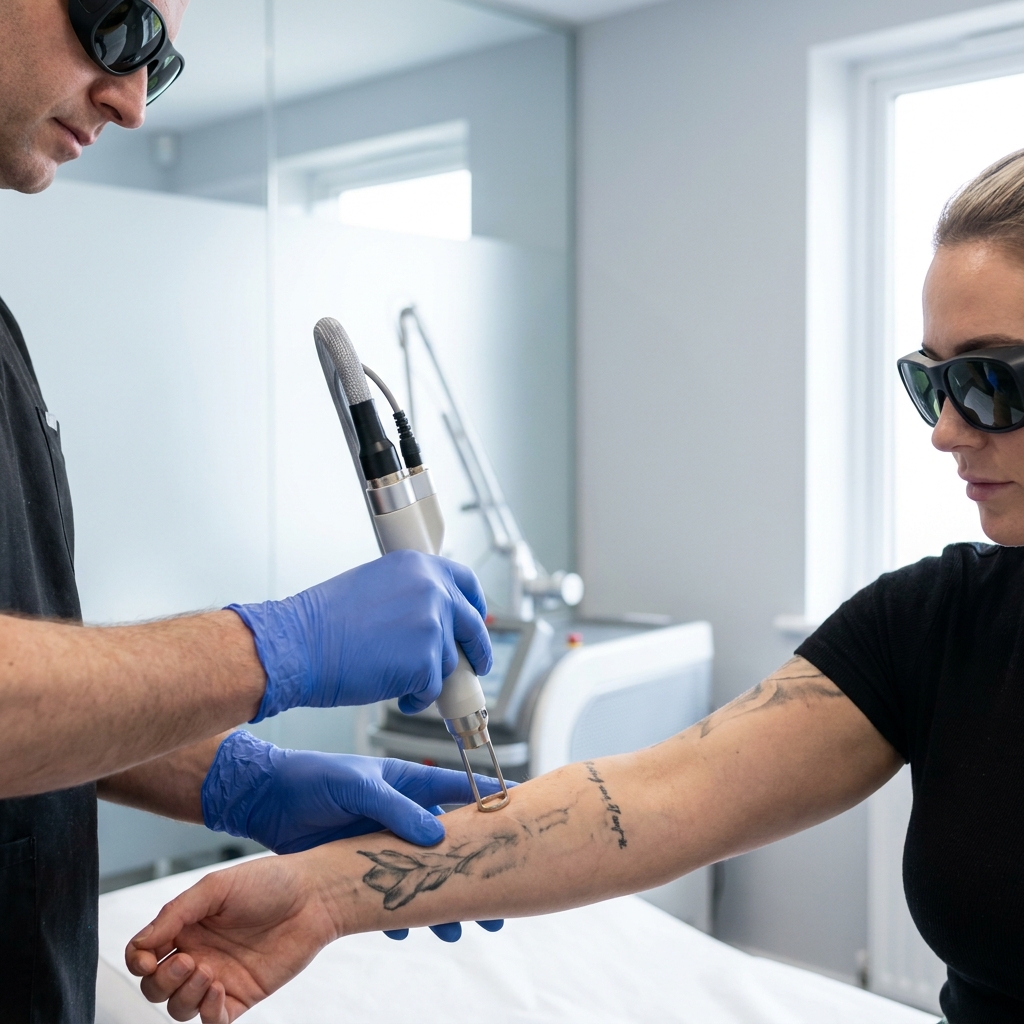
The short answer
Most UK clinics charge roughly £50–£200 per session, and a full course usually needs 6–12 sessions. A small tattoo often totals £200–£600 across the whole course; larger pieces can run to £1,000 or more. Price depends on size, ink colour, age of the tattoo and the number of sessions you actually need, which is only ever an estimate until a practitioner assesses your skin and ink. The NHS does not normally fund cosmetic removal.
Tattoo removal is priced per session, but you pay for a course — so the figure that matters is the total across every visit, not the headline cost of a single appointment. Because no two tattoos respond identically, any quote before a consultation is an estimate. This page sets out the typical UK ranges for 2026, explains what pushes a quote up or down, and shows how to compare clinics fairly.
Tattoo removal cost at a glance
- Per session Roughly £50–£200
- Small tattoo, full course Often £200–£600
- Large piece £1,000+
- Sessions needed Typically 6–12
- Session spacing 6–8 weeks apart
- NHS funding Not normally available
What a UK course typically costs
UK laser tattoo removal is almost always sold by the session, with most clinics charging somewhere between £50 and £200 each time. The exact figure within that band is driven mostly by the physical size of the tattoo: a thumbnail-sized symbol sits at the bottom of the range, while a palm-sized or larger design sits at the top. Because pigment is cleared gradually by your own immune system in the weeks between visits, removal cannot be done in one go — you are buying a course, and the number that really matters is the sum of every appointment, not the headline price of one.
For a small, simple, black tattoo, a full course often comes to £200–£600 once you add up every session. Medium designs land higher, and large or intricate multi-colour pieces — a half-sleeve, a back piece, a chest panel — can total £1,000 or more. Those figures assume the usual 6–12 sessions; a stubborn or colourful tattoo that needs more visits will cost more. See small tattoo removal cost and sleeve tattoo removal cost for worked examples at each end of the scale.
| Tattoo | Per session | Typical full course |
|---|---|---|
| Small (coin-sized) | £50–£90 | £200–£600 |
| Medium (palm-sized) | £90–£150 | £600–£1,200 |
| Large (sleeve / back) | £150–£200+ | £1,000+ |
What makes the price go up
Several factors decide how many sessions you need and therefore the total bill. Size is the most obvious, but it is rarely the whole story, and two tattoos of identical dimensions can have very different totals:
- Size — the single biggest driver of both per-session and total cost, because a larger area takes longer to treat and more passes to clear.
- Ink colour — black responds best of all; green, light blue and yellow are notoriously harder and may need more sessions, raising the total.
- Age and depth of the ink — older, naturally faded tattoos and amateur work often clear faster than dense, modern professional ink.
- Skin tone — settings are adjusted for safety on darker skin, which can affect the pace of treatment and the spacing between sessions.
- Location on the body — areas with good circulation, such as the upper body, tend to clear more readily than the hands, feet and lower legs.
Because these factors interact, the number of sessions — and therefore the cost — is always an estimate at the outset, refined as the practitioner sees how your tattoo responds. Read how many sessions you need and cost per session to understand how the running total builds across a course.
Why the NHS rarely pays
The NHS does not normally fund tattoo removal because it is considered a cosmetic procedure rather than a clinical necessity. Removal is funded only in rare, exceptional circumstances — for example where a tattoo causes significant psychological distress — and any such decision rests with the local NHS commissioner following a clinical assessment, usually via a GP referral. You should not plan on the basis that free treatment will be available; for the limited charitable and specialist routes that do exist, see free tattoo removal in the UK. For most people, removal is a private, self-funded course.
How to compare clinics fairly
Always ask for the likely total course cost, not just the per-session price, and check whether a consultation and patch test are included or charged separately. A cheaper session is not cheaper overall if the clinic uses underpowered equipment that needs more visits to reach the same result, so a low headline rate can hide a longer, costlier course. Ask how the clinic prices — a flat fee, by area, or per minute — so you are comparing like with like.
Above all, let safety lead the decision. Confirm the practitioner is appropriately trained and that the clinic is registered with the relevant regulator for your nation of the UK — Healthcare Improvement Scotland, Healthcare Inspectorate Wales, the RQIA in Northern Ireland, or local-authority special-treatment licensing and the CQC where treatment is doctor-led in England. This page is general information, not medical advice; suitability and an accurate quote depend on a face-to-face consultation.
Frequently asked questions
Why is tattoo removal priced per session?
Because pigment is cleared gradually by your immune system between appointments, removal happens over a course rather than in one visit. Clinics charge per session, so the figure that matters is the total across all the sessions you need.
Can a clinic tell me the exact total in advance?
No — only an estimate. The number of sessions depends on your ink, skin and tattoo, which a practitioner assesses at a consultation and patch test. Treat any ‘guaranteed’ total with caution.
Is laser removal cheaper than a cover-up tattoo?
It varies. A cover-up is usually a one-off cost, while removal is a course. Sometimes people remove a tattoo partially before a cover-up; see our guide on removal before a cover-up for the trade-offs.
Does the NHS pay for tattoo removal?
Not normally. It is treated as cosmetic and funded only in rare, exceptional cases at the discretion of the local NHS commissioner after a clinical assessment.
Sources & further reading
- NHS — Cosmetic procedures: laser and light treatments and what to consider before having one
- MHRA — Guidance on lasers, intense pulsed light (IPL) and LED systems
- JCCP — Joint Council for Cosmetic Practitioners register and standards for non-surgical cosmetic treatments
- CIEH — Chartered Institute of Environmental Health guidance on special treatment licensing
This guide is general information, not medical advice. A patch test and consultation with a qualified, regulated practitioner are essential before treatment, and results vary by individual. Discuss any skin or health concerns with the practitioner or your GP.