The short answer
Most tattoos need around 6–12 sessions, spaced 6–8 weeks apart, though stubborn ink can take more. Each laser session shatters a portion of the pigment, and your immune system clears it over the following weeks — which is why visits are spread out and why a full course takes months. The exact count depends on ink colour, density, age, your skin and the tattoo’s location, so it can only be estimated until a practitioner assesses you.
There is no fixed number of sessions for laser tattoo removal. Six to twelve is the usual range, but the true figure is decided by how your particular tattoo and skin respond. Understanding why removal is staged — and what shortens or lengthens a course — helps you set realistic expectations and budget sensibly before you start.
Sessions at a glance
- Typical range 6–12 sessions
- Stubborn ink Sometimes more
- Spacing 6–8 weeks apart
- Easiest ink Black
- Hardest colours Green, light blue, yellow
- Total time Often 9–18 months
Why removal needs several sessions
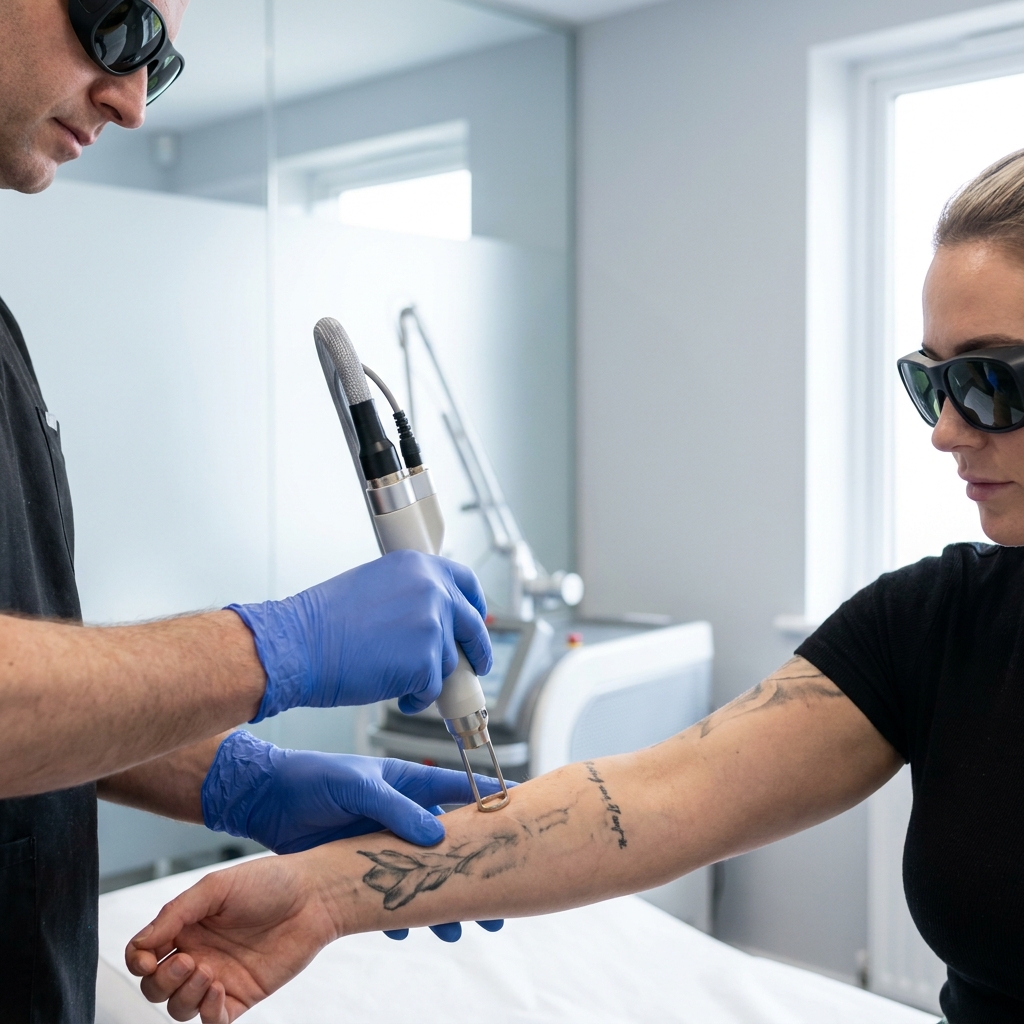
A laser does not erase a tattoo on contact. It delivers very short pulses of light that are absorbed by the ink and shatter the pigment into tiny fragments. Your immune system then carries those fragments away over the following weeks, which is why a tattoo continues to fade between appointments. Each session can only break down a portion of the pigment safely, so the tattoo lightens step by step across a course rather than vanishing in one go. This is the same mechanism explained in how tattoo removal works and how lasers break down ink.
Because the body needs time to clear pigment and the skin needs time to recover, sessions are spaced roughly 6–8 weeks apart. Crowding them closer does not speed up clearance — the immune system works at its own pace — and it raises the risk of blistering, prolonged redness and skin reactions. The full reasoning is in session spacing. The established technology behind all of this is the Q-switched and picosecond laser, which is designed to target ink while sparing the surrounding skin.
What decides your number
Within the usual 6–12 range, several factors move you up or down, and they often combine:
- Ink colour — black absorbs laser light well and tends to clear fastest; green, light blue and yellow are notoriously harder and can add several sessions.
- Ink density and layering — bold, saturated or layered designs hold more pigment and need more passes than fine linework.
- Age of the tattoo — older, naturally faded tattoos often need fewer sessions than fresh, vivid ink.
- Professional vs amateur — amateur tattoos are often shallower and less uniform, so they can clear more readily.
- Your skin and health — circulation, immune response, smoking status and skin tone all influence the pace.
- Location — areas with good blood flow clear faster than the hands, feet and lower legs, where circulation is poorer.
Because these factors interact, nobody can give you a precise figure in advance. A practitioner estimates the likely range and then refines it as your tattoo responds.
| Tattoo type | Likely session count |
|---|---|
| Small amateur black | Toward the lower end (around 6–8) |
| Professional black, dense | Mid-range (around 8–10) |
| Multi-colour with greens/blues | Higher end or more (10–12+) |
How long the whole course takes
Because sessions are weeks apart, a course usually spans many months — often 9 to 18 months from start to finish, and longer for large or colourful pieces. Patience is genuinely part of the process; rushing it does not improve the result and can harm your skin. If you are removing a tattoo before a particular event or a cover-up, start early and build in extra time, because the final count is only an estimate. For the calendar view, read how long tattoo removal takes.
Getting a realistic estimate
A reputable clinic will only estimate your session count after a consultation and patch test, then refine it as they see how your tattoo responds over the first few visits. This staged honesty is a good sign; a confident, fixed promise is not. Because each session adds to the bill, the count directly drives the total cost — see tattoo removal cost and cost per session. This page is general information, not medical advice; your individual treatment plan should come from a qualified practitioner who has assessed your skin and ink in person.
Frequently asked questions
Why can’t removal be done in one session?
Each session can only safely break down part of the ink, and your immune system needs weeks to clear the fragments. Treating too aggressively in one visit risks skin damage, so removal is staged.
Will I definitely need 12 sessions?
Not necessarily. Six to twelve is the usual range, but small, old or amateur black tattoos may need fewer, while dense or coloured ink may need more. It is always an estimate.
Why are sessions weeks apart?
Spacing of 6–8 weeks lets your body clear shattered pigment and allows the skin to recover fully, which protects against side effects and gives a clearer view of progress.
Can a clinic guarantee my tattoo will be gone after the course?
No. Complete removal cannot be guaranteed. Many tattoos fade dramatically, but some pigment, especially certain colours, can remain. A practitioner will give an honest, individual assessment.
Sources & further reading
- NHS — Cosmetic procedures: laser and light treatments
- MHRA — Regulation of lasers and intense pulsed light (IPL) devices
- British Medical Laser Association (BMLA) — guidance on laser treatments and practitioner standards
- JCCP — standards for non-surgical cosmetic procedures and practitioner registration
This guide is general information, not medical advice. A patch test and consultation with a qualified, regulated practitioner are essential before treatment, and results vary by individual. Discuss any skin or health concerns with the practitioner or your GP.