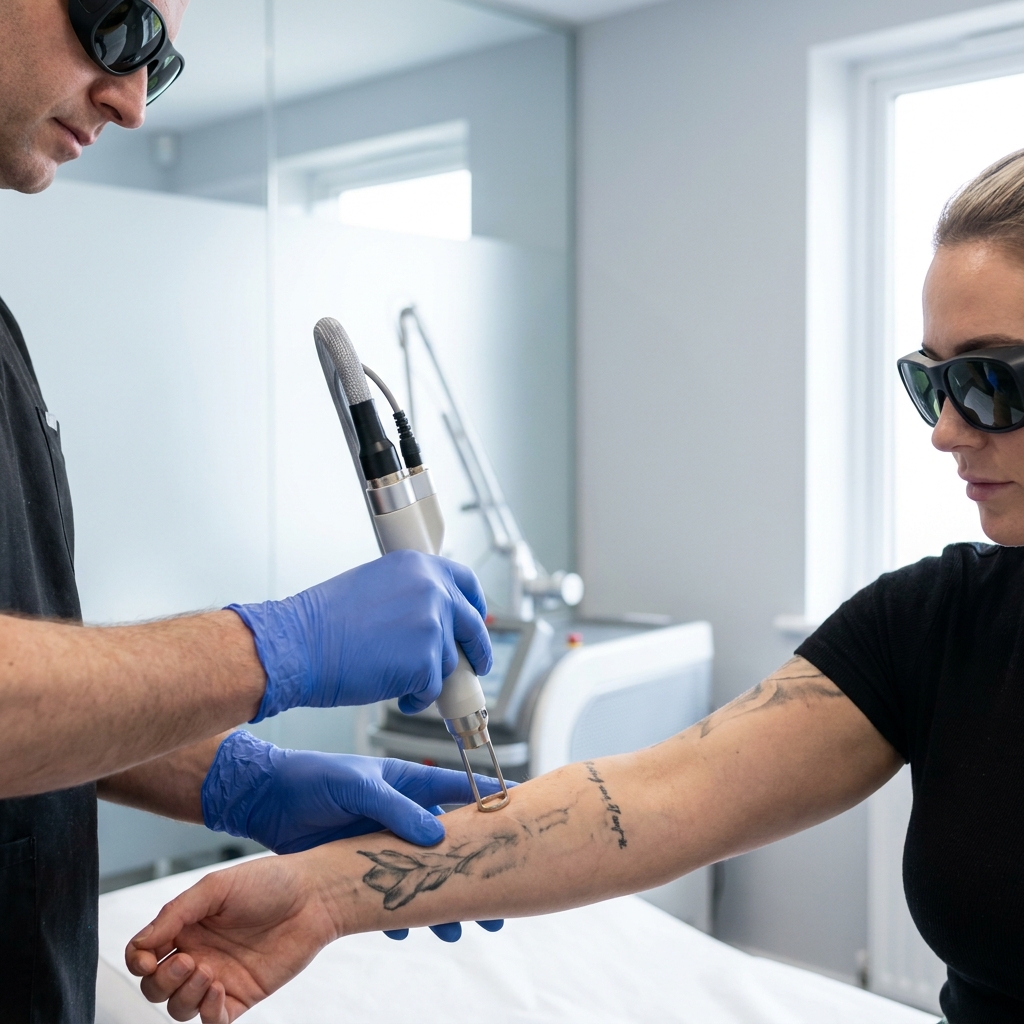
The short answer
Tattoo removal uses Q-switched (nanosecond) and picosecond lasers, which fire ultra-short, high-energy pulses to shatter ink. Different wavelengths target different ink colours — commonly 1064 nm and 532 nm, with others for stubborn colours. IPL is not a tattoo removal device and can be unsafe for ink. Knowing which machine a clinic uses, and why it suits your tattoo, is part of choosing safely. This is general information, not medical advice, and results vary by individual.
Not all light-based devices remove tattoos, and the machine a clinic uses has a real bearing on safety and results. This guide explains the laser types that genuinely work — Q-switched and picosecond — how wavelength relates to ink colour, and why some devices marketed for skin treatments should never be used on tattoos.
Machine types at a glance
- Established lasers Q-switched (nanosecond) & picosecond
- How they work Ultra-short, high-energy pulses
- Common wavelengths 1064 nm and 532 nm
- Best response Black ink
- Harder colours Green, light blue, yellow
- Not for tattoos IPL devices
The lasers that remove tattoos
Effective tattoo removal relies on lasers that deliver energy in extremely short bursts — short enough to shatter ink particles without overheating the surrounding skin. Two families dominate: Q-switched lasers, which fire in nanoseconds (billionths of a second), and picosecond lasers, which fire even faster, in trillionths of a second. Both work on the principle of photothermal and photomechanical action: the pulse heats and fractures the pigment into fragments small enough for the body’s immune system to carry away gradually over the weeks after each session. You can read more about this mechanism in how lasers break down ink and the speed difference in picosecond vs nanosecond lasers.
The reason the pulse must be so short comes down to protecting the skin. If the same energy were delivered slowly, it would heat the surrounding tissue and risk burns; delivered in a flash measured in billionths or trillionths of a second, it is absorbed by the ink and dissipated before it can damage the skin around it. This is the single feature that separates a genuine tattoo removal laser from ordinary light-based devices, and it is why the technology, not just the operator, has to be right for the job.
Wavelength and ink colour
A single laser setting does not suit every colour. Different wavelengths of light are absorbed by different pigments, which is why versatile machines offer more than one. The most common is 1064 nm, which suits dark inks and is generally safer on darker skin, while 532 nm targets red and warmer colours. Additional wavelengths exist for stubborn colours such as green and blue. This is why black ink usually clears most readily and colours such as green, light blue and yellow can be the hardest — a point explored in tattoo ink colours and removal.
| Wavelength | Targets | Notes |
|---|---|---|
| 1064 nm | Black and dark inks | Often safer for darker skin tones |
| 532 nm | Red and warm colours | Common second wavelength |
| Other wavelengths | Green, blue and stubborn colours | Available on more versatile machines |
Q-switched versus picosecond
Both technologies are established and effective, and a skilled practitioner with a good Q-switched laser can achieve excellent results. Picosecond lasers deliver even shorter pulses, which can fragment ink into finer particles and may, in some cases, clear certain colours or stubborn tattoos in fewer sessions. They are typically newer and more expensive, which can be reflected in price. The right choice depends on your tattoo, your skin and the practitioner’s expertise — a well-used Q-switched machine in skilled hands often outperforms a picosecond laser used carelessly.
- Q-switched — nanosecond pulses; established, widely available.
- Picosecond — trillionth-of-a-second pulses; can suit stubborn colours.
- Both — require correct wavelength selection for your ink.
- Operator skill — matters as much as the machine itself.
Why IPL is not tattoo removal
A crucial safety point: intense pulsed light (IPL) devices, used for some hair and skin treatments, are not tattoo removal lasers. IPL emits a broad spectrum of light rather than a single, precisely targeted wavelength, and using it on a tattoo can cause burns, blistering and scarring while failing to remove the ink. Any provider proposing IPL for a tattoo does not understand the technology.
What this means when choosing a clinic
You do not need to become an engineer, but knowing the basics lets you ask better questions. When comparing clinics, ask which laser they use, which wavelengths it offers, and why it suits your ink and skin tone. A confident answer that matches your tattoo’s colours is reassuring; an evasive one, or a suggestion of IPL, is not. Combine this with the safety checks in questions to ask and choosing a clinic so the machine, the wavelengths and the practitioner’s skill all line up with what your tattoo actually needs. Remember, too, that the newest or most expensive machine is not automatically the best one for you; a versatile laser with the right wavelengths in experienced hands matters more than a marketing name. Let the answers about technology sit alongside everything else you have learned, and choose the clinic where machine, method and practitioner all fit your particular tattoo.
Frequently asked questions
Which lasers are used for tattoo removal?
Q-switched (nanosecond) and picosecond lasers. Both fire ultra-short, high-energy pulses to shatter ink, which the body then clears gradually over the weeks after each session.
Is a picosecond laser better than a Q-switched one?
It can suit certain stubborn colours and sometimes needs fewer sessions, but a skilled practitioner with a good Q-switched laser also achieves excellent results. Operator skill matters as much as the machine.
Can IPL remove a tattoo?
No. IPL is not a tattoo removal device. Using it on a tattoo can cause burns and scarring without removing the ink. Only Q-switched or picosecond lasers should be used.
Why does wavelength matter?
Different ink colours absorb different wavelengths of light. Versatile machines offer several — commonly 1064 nm and 532 nm — so the laser can be matched to your tattoo’s colours.
Sources & further reading
- NHS — Laser and IPL treatments and cosmetic procedures
- MHRA — Regulation of lasers and intense light source devices
- British Medical Laser Association (BMLA) — laser technology and safety
- NHS — Skin types and laser suitability
This guide is general information, not medical advice. A patch test and consultation with a qualified, regulated practitioner are essential before treatment, and results vary by individual. Discuss any skin or health concerns with the practitioner or your GP.