The short answer
A tattoo fades in stages across a course of sessions, not all at once. Each laser session shatters more ink, the skin reacts and heals over days, and your immune system clears pigment over the following weeks. The tattoo lightens progressively — often quickly at first with black ink, then more slowly as stubborn or deeper pigment remains. A typical course is 6–12 sessions, 6–8 weeks apart.
Tattoo removal is a process with a rhythm: a session, a healing phase, a clearing phase, then the next session. Understanding what happens at each stage helps you judge whether your tattoo is progressing normally and why patience between visits matters. This page walks through the fading stages from the first pulse to the final review.
Fading timeline at a glance
- Immediately after Frosting, then redness/swelling
- First days Skin heals, possible blistering
- Weeks after Immune system clears pigment
- Across the course Progressive lightening
- Full course 6–12 sessions, 6–8 weeks apart
What happens during a single session
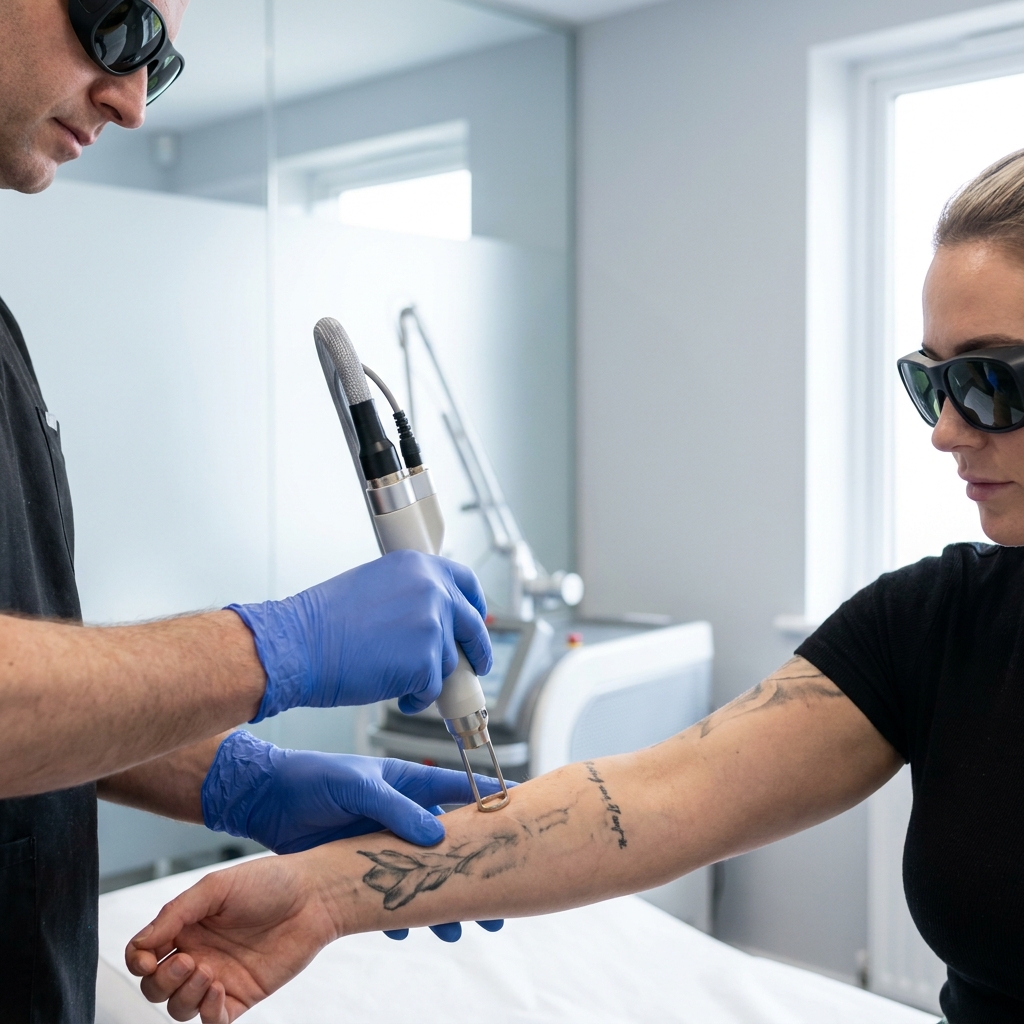
When the laser fires, the energy is absorbed by the ink and instantly fragments it. You may see a temporary whitish “frosting” over the tattoo — a normal reaction as gas is released in the skin — which fades within minutes. The area then becomes red and a little swollen, much like mild sunburn, and may feel tender for a short while. This is the visible part of the process, but it is not where the fading happens; the laser only sets up the change that your body completes over the following weeks. The mechanism is covered on how lasers break down ink; the sensation is discussed on does tattoo removal hurt.
The healing stage: the days after
Over the following days the skin recovers. Redness and swelling settle, and some people develop blisters or scabs, which is a recognised part of healing rather than a sign something has gone wrong — see tattoo removal blisters and aftercare. It is important not to pick scabs or burst blisters, as this raises the risk of scarring and infection. Good aftercare — keeping the area clean, protected and out of the sun — protects the skin while it heals and helps the final result.
The clearing stage: the weeks after
The actual fading happens after the session, not during it. Once the ink is fragmented, your lymphatic system gradually carries the particles away over the following weeks. This is why sessions are spaced 6–8 weeks apart — the gap gives your body time to clear the previous round and lets the skin fully recover before the next. Trying to shorten this gap does not speed up the result; it simply treats skin that has not finished clearing or healing. The spacing is explained on session spacing.
| Stage | When | What you notice |
|---|---|---|
| Treatment | During session | Frosting, then redness and swelling |
| Healing | First days | Settling redness; possible blisters or scabs |
| Clearing | Following weeks | Tattoo gradually lightens |
| Review | Before next session | Progress assessed, plan adjusted |
How fading progresses across the course
Across a full course, fading is rarely even. With black ink you often see encouraging early progress, then a slower phase as deeper or more stubborn pigment remains. Coloured inks may lag behind the black. It is normal for the last traces to be the most stubborn, and a faint shadow can persist even at the end of a long course. Because you see the tattoo every day, the change can feel slower than it is, which is why comparison photographs taken at each visit are so useful. The overall outlook is summarised on tattoo removal results.
- Early sessions — often the most visible change, especially with black.
- Middle sessions — steady lightening; colours and dense areas catch up slowly.
- Later sessions — diminishing returns as only the toughest pigment remains.
- Final review — a practitioner judges whether more sessions are worthwhile.
What to do if fading stalls
If your tattoo seems to stop fading, that does not always mean it is finished — clearance continues for weeks after each session, and stubborn colours simply take longer. Sometimes a longer gap before the next session, a change of laser settings or a different wavelength helps. A practitioner will assess progress against your earlier photographs and advise honestly whether further sessions are likely to help or whether you have reached the realistic limit for that ink. This page is general information, not medical advice; if your skin reacts unexpectedly between sessions — for example signs of infection — contact your practitioner or seek advice from the NHS.
Frequently asked questions
Why does my tattoo look the same right after a session?
Because fading happens in the weeks afterwards, not during treatment. Once the laser fragments the ink, your immune system clears it gradually, so you see the change over the following weeks.
Is the white frosting during treatment normal?
Yes. The temporary whitish frosting is a normal immediate reaction as the laser interacts with the ink. It usually settles within minutes, followed by redness and swelling.
Why has my fading slowed down?
Stubborn, deep or coloured ink clears more slowly, and the last traces are often the hardest. A practitioner can confirm whether it is still progressing or has plateaued.
Can I speed up the fading between sessions?
Not reliably. Following aftercare and keeping the area healthy supports clearance, but the pace is set mainly by the ink and your body. Don’t shorten the 6–8 week gaps.
Sources & further reading
- NHS — Laser and intense pulsed light (IPL) treatments
- NHS — Tattoos: looking after a tattoo and possible problems
- MHRA — Lasers, intense light source systems and LEDs: guidance
- NHS — Cosmetic procedures: things to consider before you go ahead
This guide is general information, not medical advice. A patch test and consultation with a qualified, regulated practitioner are essential before treatment, and results vary by individual. Discuss any skin or health concerns with the practitioner or your GP.