The short answer
Most tattoos fade significantly over a course of treatments, but complete removal cannot be guaranteed. Results build gradually across roughly 6–12 sessions spaced 6–8 weeks apart, as your immune system clears laser-fragmented ink. Black ink usually clears best; some colours and stubborn pieces fade only partially. Your skin tone, the ink’s depth and age, and your general health all shape the outcome. A qualified practitioner can give a realistic estimate at consultation.
It is the question every client asks first: will my tattoo actually disappear? The honest answer is that laser removal is a gradual process of fading, not an instant erase, and the final result varies from person to person. This page sets out what realistic results look like, how they build over a course of treatment, and the factors that decide whether a tattoo clears fully or only lightens.
Results at a glance
- Typical course 6–12 sessions, sometimes more
- Session spacing 6–8 weeks apart
- Best-responding ink Black and dark colours
- Hardest colours Green, light blue, yellow
- Guarantee of full removal No — results vary by individual
Results are a gradual fade, not an instant erase
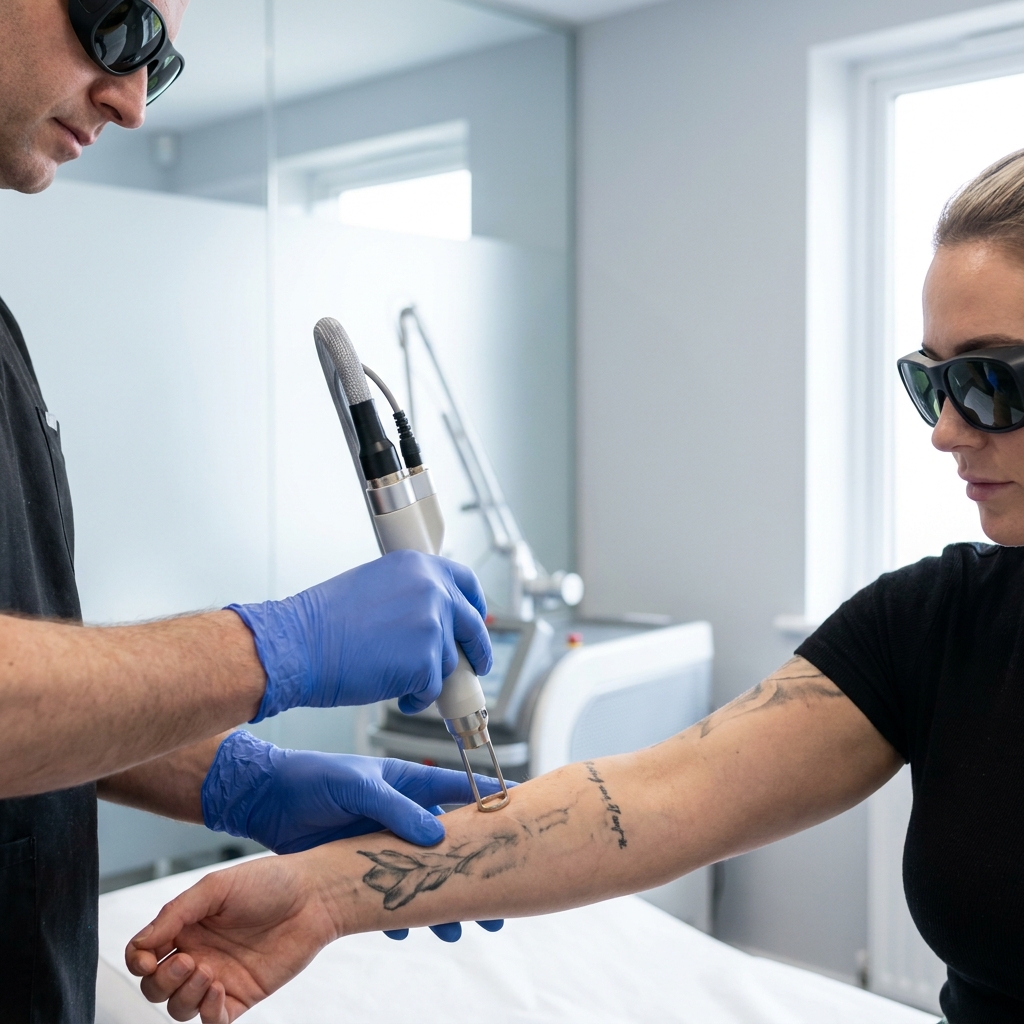
Laser tattoo removal works by sending short, high-energy pulses of light into the skin. The light is absorbed by the tattoo pigment and shatters it into tiny fragments. Your body’s immune system then carries those fragments away through the lymphatic system over the following weeks. Because this clearance happens slowly, and because only a portion of the ink is fragmented at each visit, the tattoo lightens step by step rather than vanishing in one go. There is no single treatment that erases a tattoo instantly and safely, so anyone expecting an overnight result will be disappointed. You can read the mechanism in detail on how tattoo removal works and how lasers break down ink.
After a single session you may notice the tattoo looks a little lighter or hazier, but the most visible change usually appears once several treatments have stacked up. A realistic course is around 6–12 sessions, spaced 6–8 weeks apart so the skin can recover and the body can clear the previous round of pigment. Stubborn pieces can take more, and a faint shadow sometimes remains even after a long course. Setting that expectation early is the single most useful thing you can do before starting treatment.
What a realistic outcome looks like
For many people, the goal of a clean, ink-free patch of skin is achievable with black professional ink in a healthy area of the body. For others, the realistic result is a substantial fade rather than total disappearance — enough to make the tattoo far less visible, or light enough to take a successful cover-up. No reputable clinic will promise a guaranteed clean slate, because the outcome depends on factors no one can fully control. It is far better to begin with a realistic expectation of a strong fade and be pleasantly surprised than to expect perfection and feel let down.
| Outcome | Who tends to see it |
|---|---|
| Near-complete clearance | Black professional ink, good blood supply, healthy non-smoker |
| Strong fade, faint shadow remains | Older or multicoloured tattoos, dense ink |
| Partial fade only | Green, light blue or yellow ink; some cosmetic pigments |
| Fade for cover-up | Anyone wanting a new design over the old — usually fewer sessions |
What changes the result you get
The same laser, in the same hands, produces different results on different tattoos. The reason is that removal depends not only on the technology but on the tattoo itself and on your own body’s ability to clear pigment. The main influences are:
- Ink colour — black absorbs all laser wavelengths and clears best; see tattoo ink colours and removal.
- Ink depth and density — heavily layered or deeply placed ink needs more sessions than light, shallow work.
- Age of the tattoo — older tattoos have already begun to fade naturally and often respond faster.
- Location on the body — areas with better blood supply, such as the upper body, clear faster than the hands, fingers, ankles and feet.
- Your skin tone and general health — both affect the settings used and how efficiently you clear pigment; smoking can slow results.
The full picture is set out on factors affecting tattoo removal. Because these factors combine differently for everyone, two people with similar-looking tattoos can have very different journeys, and that is why a consultation matters before you commit to a course.
How progress is measured
Throughout a course, a good practitioner photographs and reviews the tattoo, usually every few sessions, comparing it against earlier images so progress can be judged objectively rather than by memory. This matters because fading is gradual and easy to underestimate when you see the tattoo every day. The review also lets the practitioner adjust the laser, the settings or the spacing if a tattoo is responding slowly, and to be honest with you if results are plateauing. Knowing this in advance helps you stay patient through the slower middle and later sessions, when only the most stubborn pigment remains.
How to set realistic expectations
The best way to understand your likely result is a consultation with a qualified practitioner, who can assess the ink, your skin and the tattoo’s location, and recommend a patch test before any full treatment. A patch test also shows how your skin reacts and gives an early clue to how the ink will respond. Ask about likely session numbers, the chance of full clearance versus a strong fade, and what the cost of a full course is likely to be — covered on tattoo removal cost. This page is general information, not medical advice; your individual outcome can only be judged by a practitioner assessing your tattoo in person.
Frequently asked questions
Will my tattoo disappear completely?
Maybe, but it cannot be guaranteed. Many black tattoos clear almost completely, while some colours and older or denser pieces fade only partially. A practitioner can give a realistic estimate after assessing your tattoo and a patch test.
How soon will I see results?
Some lightening can appear after the first session, but the most visible fading usually builds up over several treatments spaced 6–8 weeks apart, as your body clears the fragmented ink between visits.
Why do results vary so much between people?
Ink colour, depth and age, the tattoo’s location, your skin tone and your general health all affect how well pigment clears, so two similar tattoos can respond very differently.
Can poor results be improved?
Sometimes additional sessions, a different laser or more time between treatments help, but some residual shadow may remain. A qualified practitioner can advise whether further treatment is worthwhile.
Sources & further reading
- NHS — Laser and intense pulsed light (IPL) treatments
- NHS — Cosmetic procedures: things to consider before you go ahead
- MHRA — Lasers, intense light source systems and LEDs: guidance
- JCCP — Joint Council for Cosmetic Practitioners patient guidance
This guide is general information, not medical advice. A patch test and consultation with a qualified, regulated practitioner are essential before treatment, and results vary by individual. Discuss any skin or health concerns with the practitioner or your GP.