The short answer
A patch test is a small trial of the laser on part of your tattoo before a full course. It checks how your skin reacts — redness, blistering, pigment change — and helps the practitioner set safe, effective parameters. It is especially important for darker skin tones, where the risk of pigment change is higher. A responsible clinic always patch tests and usually waits a week or two before the first full session. Skipping it is a red flag. This is general information, not medical advice, and results vary.
A patch test is one of the simplest yet most important safety steps in laser tattoo removal. By trialling the laser on a small area first, the practitioner learns how your individual skin responds before committing to a full course. This guide explains what the test involves, what it reveals, and why a clinic that skips it should give you pause.
Patch test at a glance
- What it is A small laser trial on the tattoo
- Purpose Test skin reaction and settings
- Especially for Darker skin tones
- Typical wait Around 1–2 weeks before full treatment
- Reveals Redness, blistering, pigment change
- Skipping it A clear warning sign
What a patch test is
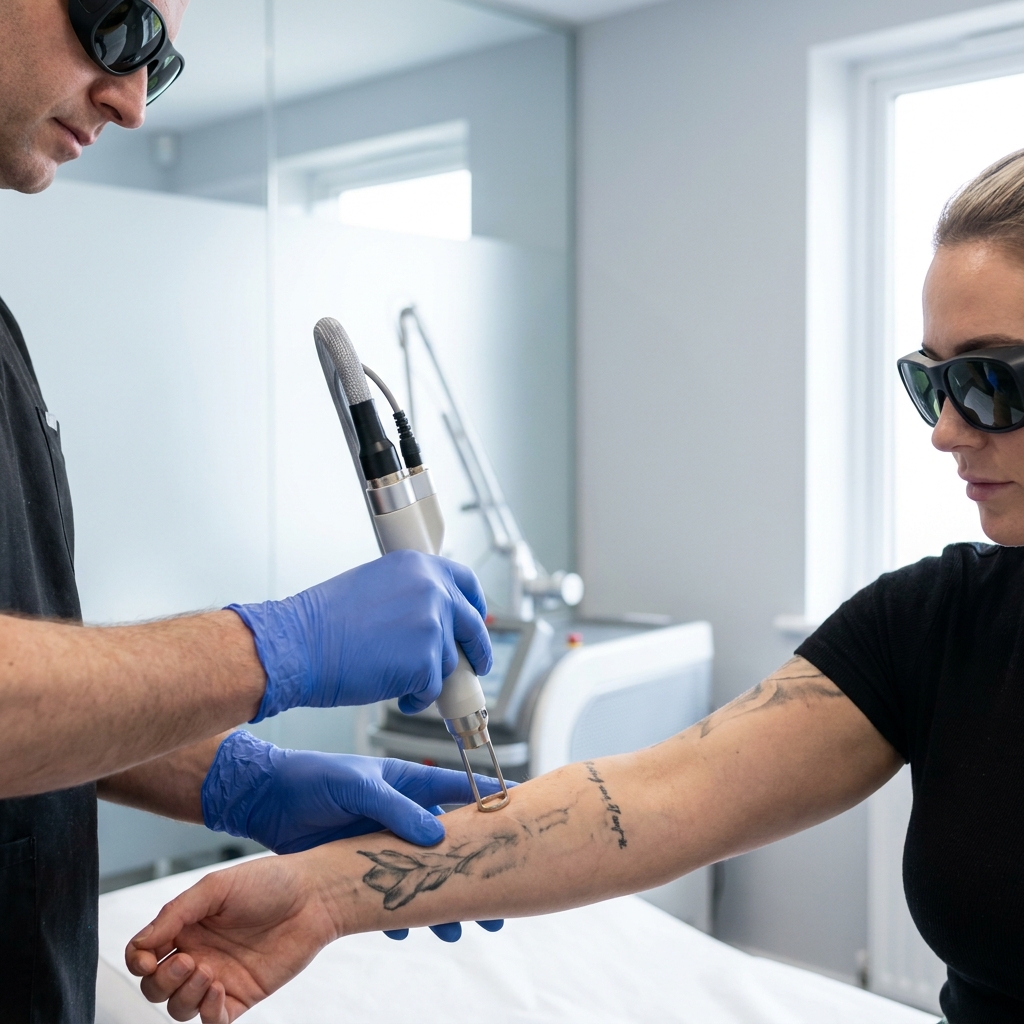
A patch test is a brief, controlled trial in which the practitioner fires the laser over a small section of your tattoo — often a discreet corner — at the settings they intend to use. It takes only moments and is done at or shortly after the consultation. The point is not to start removing the tattoo but to gather information: how your skin reacts to the light, whether the ink responds as expected, and whether the chosen parameters are safe for you. Because every person’s skin and every tattoo is different, this individual trial cannot be replaced by general assumptions. To understand the mechanism behind the test, see how lasers break down ink.
Think of it as a rehearsal rather than the performance. The practitioner is not trying to remove the tattoo at this stage; they are gathering the information that makes the rest of the course safer and more predictable. A small, carefully chosen area carries almost all of the learning value with almost none of the risk — which is precisely why a competent clinic treats the patch test as routine and a hurried one is tempted to skip it.
Why it matters so much
The patch test exists to catch problems on a small scale before they can happen across the whole tattoo. The laser delivers intense energy that, at the wrong settings or in unusually reactive skin, can cause excessive blistering, burns or lasting pigment change. By testing a small area and watching how it heals over the following days, the practitioner can adjust the approach before any large-scale treatment. This is particularly important for people with darker skin tones, where melanin in the skin competes for the laser’s energy and the risk of hyper- or hypo-pigmentation is higher.
- Reveals adverse reactions — before they affect the whole tattoo.
- Calibrates settings — so the full course is safer and more effective.
- Protects darker skin — where pigment-change risk is greater.
- Sets expectations — shows roughly how the ink will respond.
What the practitioner watches for
After the test, the practitioner — and you — observe how the area behaves over the next one to two weeks. Some immediate whitening (frosting), mild redness and slight swelling are normal short-term responses. What matters is how the skin heals.
| Reaction | What it suggests |
|---|---|
| Mild redness, brief frosting | Normal — expected short-term response |
| Significant blistering | Settings may need adjusting |
| Lasting pigment change | Caution needed, especially on darker skin |
| Excessive or prolonged reaction | Review suitability before continuing |
How long to wait
Because skin reactions can take days to develop fully, the practitioner usually waits around one to two weeks after the patch test before starting the first full session. This gap lets any delayed reaction show itself and confirms the skin heals cleanly. Rushing from test to full treatment on the same day defeats the purpose. The same patience underpins the spacing of the whole course — sessions are typically 6–8 weeks apart, as explained in session spacing.
What it means for your decision
Whether a clinic insists on a patch test is one of the clearest signals of how seriously it takes your safety. A careful practitioner treats it as non-negotiable and uses the result to tailor your course; a careless one may try to skip it to save time or secure a quick booking. When you are comparing clinics — as set out in choosing a clinic — ask each one directly about its patch-test policy. The answer tells you a great deal about the care you can expect for the months of treatment ahead. A clinic that explains the test without being prompted, builds the waiting period into its plan, and reviews the result with you before booking the first full session is demonstrating exactly the unhurried caution that good removal demands. That small piece of patience at the start is one of the surest signs you are in safe hands.
Frequently asked questions
Is a patch test really necessary?
Yes. It reveals how your individual skin reacts and lets the practitioner set safe parameters before treating the whole tattoo. Skipping it is a clear warning sign.
How long after a patch test can I have treatment?
Usually around one to two weeks. The wait allows any delayed reaction to appear and confirms the skin heals cleanly before a full session begins.
Does a patch test hurt?
It is brief and feels much like a full session on a small area — often compared to an elastic band snap. Any discomfort is short-lived. Tell the practitioner if it is severe.
Why is a patch test extra important for darker skin?
Melanin in darker skin competes for the laser’s energy, raising the risk of pigment change. A patch test on a small area helps the practitioner work more cautiously and safely.
Sources & further reading
- NHS — Laser and IPL treatments and skin reactions
- JCCP — pre-treatment assessment and patch testing standards
- British Medical Laser Association (BMLA) — clinical good practice
- NHS — Skin types and the Fitzpatrick scale
This guide is general information, not medical advice. A patch test and consultation with a qualified, regulated practitioner are essential before treatment, and results vary by individual. Discuss any skin or health concerns with the practitioner or your GP.