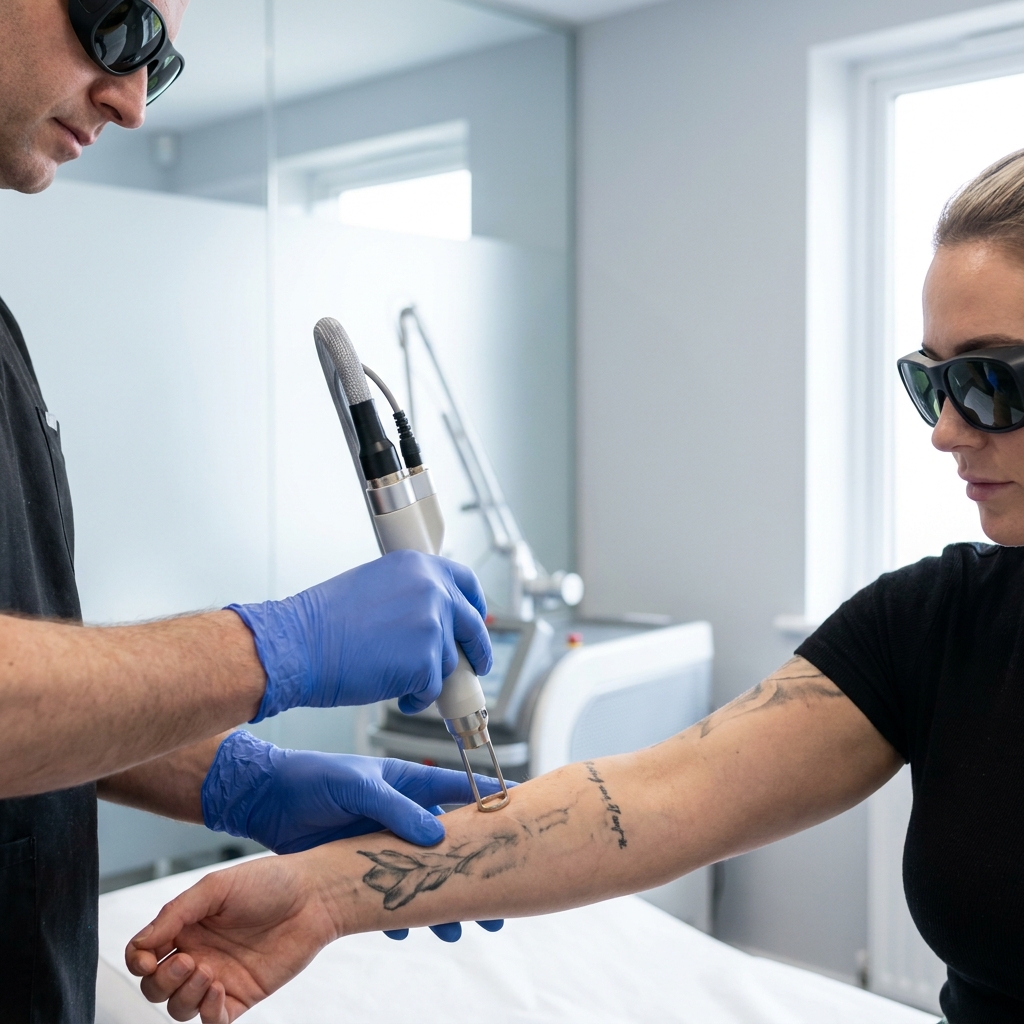
The short answer
Most tattoos can be faded substantially, but not every tattoo can be completely removed, and no clinic can guarantee a blank canvas. Black ink clears best; green, light blue and yellow are stubborn. Dense, deep, layered or amateur ink, certain pigments and some skin tones all set limits. Often the realistic goal is major fading rather than total clearance. A consultation and patch test give an honest forecast for your tattoo.
It is tempting to assume any tattoo can simply be lasered away, but the honest position is more nuanced. Some tattoos fade beautifully; others resist even a long, well-run course. Knowing what sets those limits helps you go into removal with realistic expectations rather than disappointment.
What can and can’t be removed
- Easiest Older black ink
- Hardest Green, light blue, yellow
- Harder still Dense, deep or layered ink
- Realistic aim Major fading, not always full clearance
- Never promised 100% removal
- Best forecast Consultation & patch test
The honest answer
Laser removal can fade the large majority of tattoos significantly, and many can be cleared to the point where they are very hard to see. But “faded a lot” and “completely gone” are not the same thing, and a responsible practitioner will not promise the latter. A faint shadow, slight textural difference or small pigment change can remain. This is the reality of how ink and skin behave, not a shortcoming of a particular clinic — see does tattoo removal work for the wider picture. Going in expecting major fading, with full clearance as a hoped-for bonus rather than a promise, leads to far fewer disappointments.
What makes a tattoo stubborn
Several features make a tattoo harder to remove fully. The biggest is colour: black absorbs laser light across many wavelengths and clears well, whereas green, light blue and yellow are notoriously resistant because they absorb the available wavelengths poorly. Beyond colour, the depth, density and layering of the ink matter, as does whether it was applied professionally or as an amateur or DIY piece. Professional tattoos place ink at a fairly consistent depth, while amateur ink can be uneven, making the response less predictable.
- Stubborn colours: green, light blue and yellow — see ink colours and removal.
- Dense or layered ink: more pigment for the body to clear.
- Cover-ups: a tattoo over another tattoo means twice the ink.
- Certain pigments: some modern inks contain hard-to-clear compounds.
- Position on the body: areas with poorer circulation, such as the lower legs and feet, can clear more slowly.
| Tattoo feature | Effect on removal |
|---|---|
| Black ink | Usually removes well |
| Green / light blue / yellow | Often stubborn, may not fully clear |
| Dense / deep ink | More sessions, less predictable |
| Existing cover-up | Two layers of ink — harder |
| Older, faded tattoo | Tends to clear more easily |
The role of skin and biology
Your skin tone, immune health and lifestyle also influence the result. Skin tone limits the safe laser settings, as explained in removal on different skin tones, and a healthy immune system and good circulation help clear fragmented ink. Smoking, for example, can slow clearance by reducing blood flow to the skin. Two people with apparently similar tattoos can have quite different outcomes, which is why removal is always individual and never guaranteed in advance.
When complete removal is unlikely
Sometimes the honest assessment is that full clearance is improbable — for example, a dense, multi-coloured cover-up containing stubborn pigments on skin that limits the safe settings. That does not mean removal is pointless: substantial fading may still transform how the tattoo looks, or prepare it for a new design. What matters is that you hear this realistically at the start rather than discovering it after many sessions, which is exactly what a good consultation provides.
Setting realistic goals
For a stubborn tattoo, the most useful mindset is aiming for major fading rather than perfection — which may be all you need, especially if your plan is a cover-up or partial fade. A course of 6–12 sessions, sometimes more, is typical, and the most resistant ink is usually the last to shift, so patience pays off over the final treatments. A consultation and patch test with a qualified practitioner give the most honest forecast for your specific ink, colours and skin, and a good clinic will keep reviewing progress as you go. This page is general information, not medical advice; results vary by individual and complete removal cannot be guaranteed.
Frequently asked questions
Can every tattoo be completely removed?
No. Most can be faded substantially and many cleared to barely visible, but complete removal cannot be guaranteed. Stubborn colours and dense ink may leave a faint residual mark.
Which tattoos are hardest to remove?
Green, light blue and yellow inks are the most stubborn, along with dense, deep or layered ink and cover-ups. Older black tattoos generally fade the most easily.
Why can’t coloured ink be fully removed?
Some colours absorb laser light poorly, so the laser cannot fragment them efficiently. Matching wavelengths helps, but certain pigments may never fully clear even after a long course.
What is a realistic goal for a stubborn tattoo?
Often major fading rather than total clearance — which may be enough, especially before a cover-up. A consultation gives an honest forecast for your specific tattoo.
Sources & further reading
- NHS — Cosmetic procedures and realistic expectations
- MHRA — laser and IPL device regulation
- British Medical Laser Association (BMLA) — clinical limits of removal
- JCCP — honest practitioner standards
This guide is general information, not medical advice. A patch test and consultation with a qualified, regulated practitioner are essential before treatment, and results vary by individual. Discuss any skin or health concerns with the practitioner or your GP.