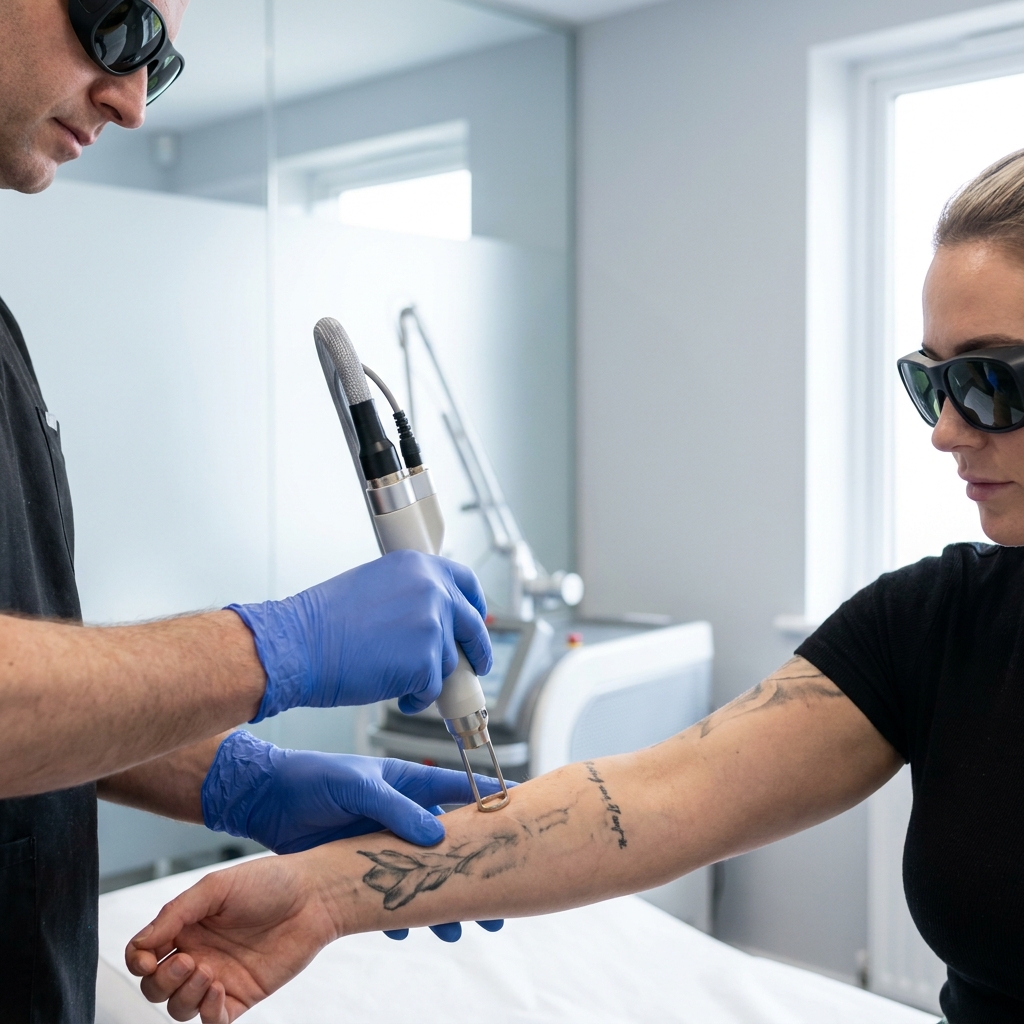
The short answer
What matters is competence, equipment and accountability, not the sign over the door. A dedicated laser clinic usually focuses on removal full-time with appropriate lasers and trained staff. A tattoo studio may also offer removal, but standards vary widely — some are excellent, others lack laser-specific training. Wherever you go, verify training, the laser used, a patch test, insurance and any regulator registration. Do not assume either venue is automatically safer. This is general information, not medical advice, and results vary.
Laser tattoo removal is offered both by dedicated clinics and by some tattoo studios, and people often assume one must be better than the other. The truth is more nuanced: the venue tells you little on its own, and the real questions are about training, equipment and oversight. This guide compares the two fairly so you can judge any provider on what actually matters.
Clinic vs studio at a glance
- What matters most Practitioner training, not venue
- Dedicated clinic Often removal-focused, trained staff
- Tattoo studio Standards vary widely
- Always verify Laser used and patch test
- Key safeguard Insurance and regulator registration
- Avoid assuming Either venue is automatically safer
Why the venue alone tells you little
It is tempting to think a medical-looking clinic must be safer than a tattoo studio, or that a studio “understands ink” better than a clinic. Neither assumption is reliable. Laser tattoo removal is a technical procedure whose safety depends on the operator’s laser-specific training, the quality and suitability of the machine, and the standards the business follows — not on whether the premises also do tattoos. A well-run tattoo studio with a properly trained laser operator and a good Q-switched or picosecond machine can be excellent; a poorly run clinic with an undertrained operator can be risky. Judge the provider, not the label. For the underlying technology, see laser tattoo removal explained.
It helps to separate two things people tend to merge: understanding tattoos and understanding lasers. A tattoo artist knows ink, skin and design intimately, but applying pigment and shattering it with a precisely tuned laser are entirely different disciplines with different risks. By the same token, a clinic that looks medical is not automatically staffed by laser experts. So the useful question is never “which type of place is best?” but “has this particular person been properly trained on this particular machine?”
What a dedicated removal clinic typically offers
Dedicated laser tattoo removal clinics usually focus on removal as their core business, which tends to bring some advantages. They often invest in appropriate lasers, treat removal cases day in and day out, and structure their service around consultation, patch testing and aftercare. Many will have staff with formal laser training and may hold JCCP registration or professional indemnity insurance specific to laser work. None of this is guaranteed by the word “clinic”, but a removal-focused business has more reason to maintain these standards.
- Focus — removal is the main service, not a sideline.
- Equipment — often purpose-bought lasers suited to a range of ink.
- Process — structured consultation, patch test and aftercare.
- Experience — high volume of removal cases.
What a tattoo studio offering removal may be like
Some tattoo studios add laser removal to their services, and the quality genuinely varies. At the better end, an artist has invested in proper laser training and a good machine and runs removal with the same care as a dedicated clinic. At the weaker end, removal is an afterthought with an inexpensive device and little laser-specific training. The familiarity of an artist with tattoos does not translate into laser competence — the two skills are different. So a studio is not inherently worse, but it requires the same scrutiny, and sometimes more.
| Factor | Dedicated clinic | Tattoo studio |
|---|---|---|
| Primary focus | Usually removal | Usually tattooing, removal added |
| Laser training | More likely formal | Varies widely |
| Equipment | Often purpose-bought | Ranges from good to basic |
| What to verify | Training, JCCP, insurance | The same — and more carefully |
The checks that apply to both
Whichever you consider, the verification is identical. Ask about laser-specific training and JCCP registration, confirm which laser is used and why it suits your tattoo, insist on a patch test, and check for professional indemnity insurance and any local regulator registration. Our questions to ask guide works equally well for a clinic or a studio.
How to decide
Rather than asking “clinic or studio?”, ask “which provider best meets the safety checks?” Shortlist on training, equipment, process and accountability, then book consultations and compare how each handles your case. A dedicated clinic will often — but not always — come out ahead because removal is its focus, yet a well-trained studio can be just as safe. Use our guides on choosing and finding a clinic to apply the same standards to every option, and let competence rather than the name on the door make your decision. In practice this means giving a well-trained studio a fair hearing and refusing to give an under-trained clinic a free pass simply because it looks the part. The label is a starting point for questions, never a substitute for the answers. Choose the provider whose training, equipment and honesty stand up to scrutiny, and the question of clinic versus studio largely answers itself.
Frequently asked questions
Is a dedicated removal clinic always better than a tattoo studio?
Not always. A dedicated clinic is often removal-focused with trained staff, but a well-run studio with a properly trained laser operator can be just as safe. Verify training and equipment in both cases.
Can a tattoo artist do laser removal safely?
They can, if they have laser-specific training and a suitable machine. Skill at tattooing does not equal skill with a laser, so check the training and ask for a patch test.
Does it matter which laser the venue uses?
Yes. Q-switched and picosecond lasers are the established technologies. Ask which laser is used and why it suits your ink and skin, at either a clinic or a studio.
What should I check at both a clinic and a studio?
The same things: laser-specific training, JCCP registration, the laser used, a patch test, professional indemnity insurance and any local regulator registration.
Sources & further reading
- NHS — Laser and IPL treatments and cosmetic procedures
- JCCP — choosing a cosmetic practitioner safely
- MHRA — Regulation of lasers and intense light source devices
- British Medical Laser Association (BMLA) — standards for practitioners
This guide is general information, not medical advice. A patch test and consultation with a qualified, regulated practitioner are essential before treatment, and results vary by individual. Discuss any skin or health concerns with the practitioner or your GP.