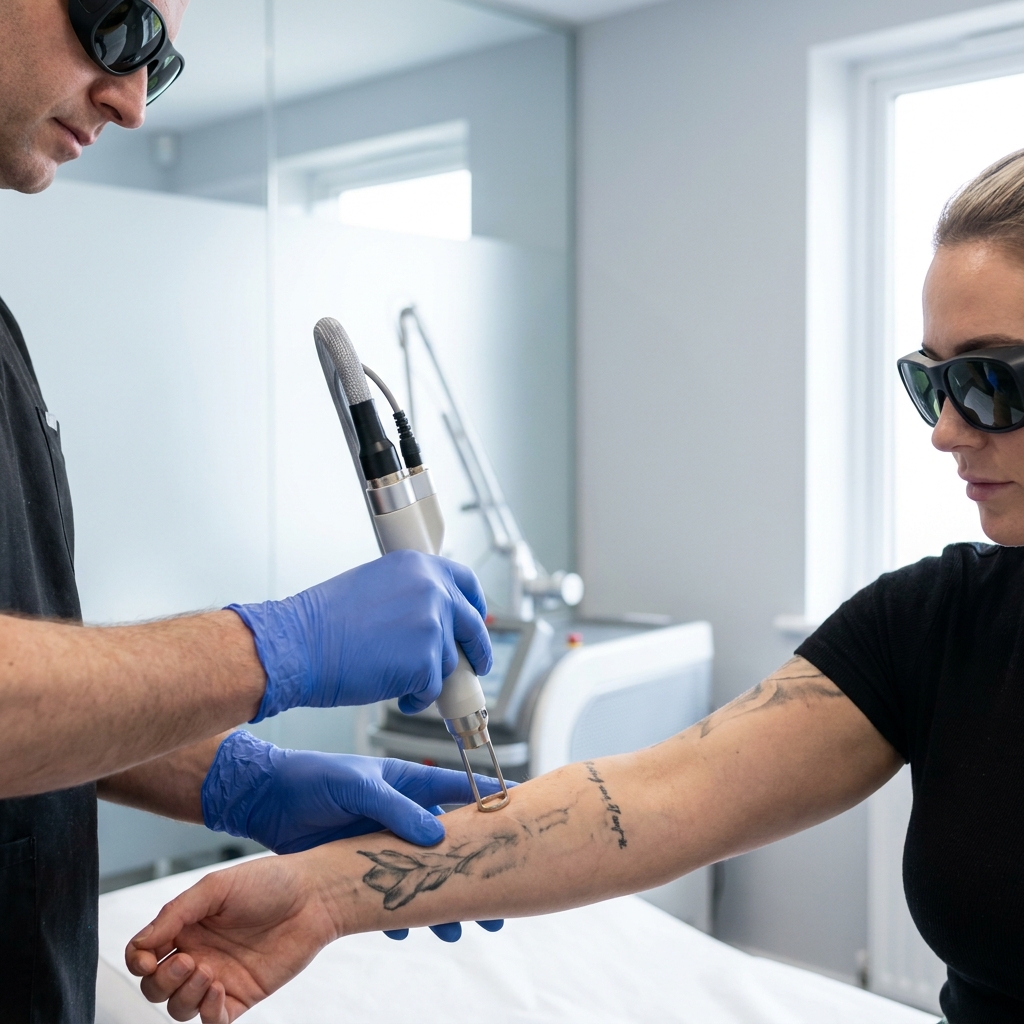
The short answer
Check training, registration, insurance and licensing yourself. Ask what laser-specific qualification the practitioner holds (such as a recognised Level 4 laser and light course), whether they are on the JCCP voluntary register, whether they carry professional indemnity insurance, and whether any local-authority licence or regulator registration applies. In much of England no one is required to verify this, so the responsibility falls to you. This is general information, not medical advice, and results vary by individual.
Because cosmetic laser tattoo removal is not consistently regulated across the UK, a confident-looking clinic is no guarantee of a qualified practitioner. The good news is that the things worth checking are concrete and easy to ask about. This guide shows you exactly how to verify that the person treating your skin is competent and accountable.
Checking qualifications at a glance
- Training Recognised laser/light qualification
- Register JCCP voluntary practitioner register
- Insurance Professional indemnity for laser work
- Licensing Local-authority or regulator registration
- Experience Time using that specific laser
- Your role Verify it yourself — often no one else will
Why you have to check yourself
In much of the UK — England especially — there is no mandatory national qualification a laser tattoo removal practitioner must hold, and no single body that vets every clinic. As our UK regulation guide explains, oversight varies by nation and, in England, council by council. The practical consequence is that you cannot assume anyone has checked the practitioner’s competence before you walk in. That makes verification your responsibility — not because most practitioners are unqualified, but because the system does not guarantee it. Asking the right questions is the only reliable safeguard.
This may feel awkward, but it is entirely reasonable. You would expect a builder to show their credentials before touching your home, and your skin deserves at least the same care. A confident, well-trained practitioner expects to be asked and will have the answers ready — certificates, an insurance document, a profile on the JCCP register. The act of asking also reveals the relationship you are entering: a clinic that treats reasonable questions as a nuisance is unlikely to handle your aftercare, or a worrying reaction, with much patience either. Treat verification as the first test of the care you can expect through the whole course.
Training and qualifications to ask about
Start with the training itself. Ask what laser-specific qualification the practitioner holds — a recognised Level 4 certificate in laser and light treatments, or equivalent, is a common benchmark — and how long they have operated the specific machine they will use on you. General beauty therapy training is not the same as laser training, so press for detail. Ask too about “core of knowledge” laser-safety training, which responsible operators are expected to have. It is fair to ask how many tattoos like yours the practitioner has treated, and whether they can show before-and-after examples of comparable work — honest examples that fade rather than miraculously vanish are more credible than perfect ones.
- Laser/light qualification — e.g. a recognised Level 4 course or equivalent.
- Machine experience — how long with this specific laser.
- Laser-safety training — core-of-knowledge for operators.
- Continuing development — evidence of keeping skills current.
Registers, insurance and licensing
Beyond training, three external checks help confirm accountability. The Joint Council for Cosmetic Practitioners (JCCP) maintains a voluntary public register; finding the practitioner on it is a strong positive sign. Professional indemnity insurance specific to laser work protects you if something goes wrong. And depending on your nation, a regulator registration or a local-authority “special treatments” licence may apply.
| Check | How to verify |
|---|---|
| JCCP registration | Search the JCCP voluntary register |
| Insurance | Ask to see proof of laser-specific indemnity cover |
| Local licence (England) | Ask the practitioner and your local council |
| Regulator (Scot/Wal/NI) | Ask if registered with HIS, HIW or RQIA |
Warning signs to act on
Some answers should change your mind. Be cautious if a practitioner cannot describe their laser training, will not show evidence of insurance, dodges questions about the machine, or claims that no qualification is needed. A refusal to provide a patch test or a promise of guaranteed complete removal are also red flags about judgement and honesty. Equally telling is how a practitioner reacts to being asked: defensiveness, irritation or vague reassurance in place of specifics all suggest someone who would rather you did not look too closely. A qualified operator has nothing to hide and will treat your diligence as sensible, not insulting.
Turning checks into a decision
Gather the answers, then compare. A practitioner who can name their laser qualification, appears on the JCCP register, shows proof of insurance, and explains any local licensing has given you good reason to trust them. Combine this with how thoroughly they assess you at the consultation and whether they insist on a patch test. Our questions to ask and choosing a clinic guides put this verification into a full decision process, so you commit to a course only once you are confident the person treating your skin is genuinely qualified.
Frequently asked questions
Is there a legal qualification a tattoo removalist must hold in the UK?
Not consistently. In much of England there is no mandatory national qualification, and oversight varies by nation. A recognised Level 4 laser and light qualification is a common benchmark to look for.
How can I check if my practitioner is on the JCCP register?
Search the Joint Council for Cosmetic Practitioners’ voluntary public register for their name. Registration is a strong positive sign of meeting defined standards.
Should my removalist have insurance?
Yes. Professional indemnity insurance specific to laser work protects you if something goes wrong. Ask to see proof, and be cautious if they cannot provide it.
What if a practitioner says no qualification is needed?
Treat it as a warning sign. While regulation is uneven, qualified practitioners do invest in laser-specific training. Dismissing the question suggests poor standards.
Sources & further reading
- JCCP — Joint Council for Cosmetic Practitioners voluntary register
- MHRA — Regulation of lasers and intense light source devices
- Chartered Institute of Environmental Health (CIEH) — special treatment licensing
- British Medical Laser Association (BMLA) — standards for practitioners
This guide is general information, not medical advice. A patch test and consultation with a qualified, regulated practitioner are essential before treatment, and results vary by individual. Discuss any skin or health concerns with the practitioner or your GP.