The short answer
Yes — laser removal can target just part of a tattoo, leaving the rest intact. Practitioners can selectively treat a section, a name, a word or a colour while preserving the design around it. It works best where the area to remove is clearly defined and separated from ink you want to keep. Precision near fine detail can be challenging, so a consultation is essential to judge what is realistic.
Not everyone wants their whole tattoo gone. You might regret a single name, want to lift a busy section before a re-work, or remove one element of a larger piece. Selective laser removal makes this possible, but it asks more of the practitioner’s precision. This page explains how partial removal works and when it is the right choice.
Partial removal at a glance
- What it does Removes part, keeps the rest
- Best for Names, words, defined sections
- Challenge Precision near kept ink
- Sessions Same course principles apply
- First step Consultation and patch test
How selective removal works
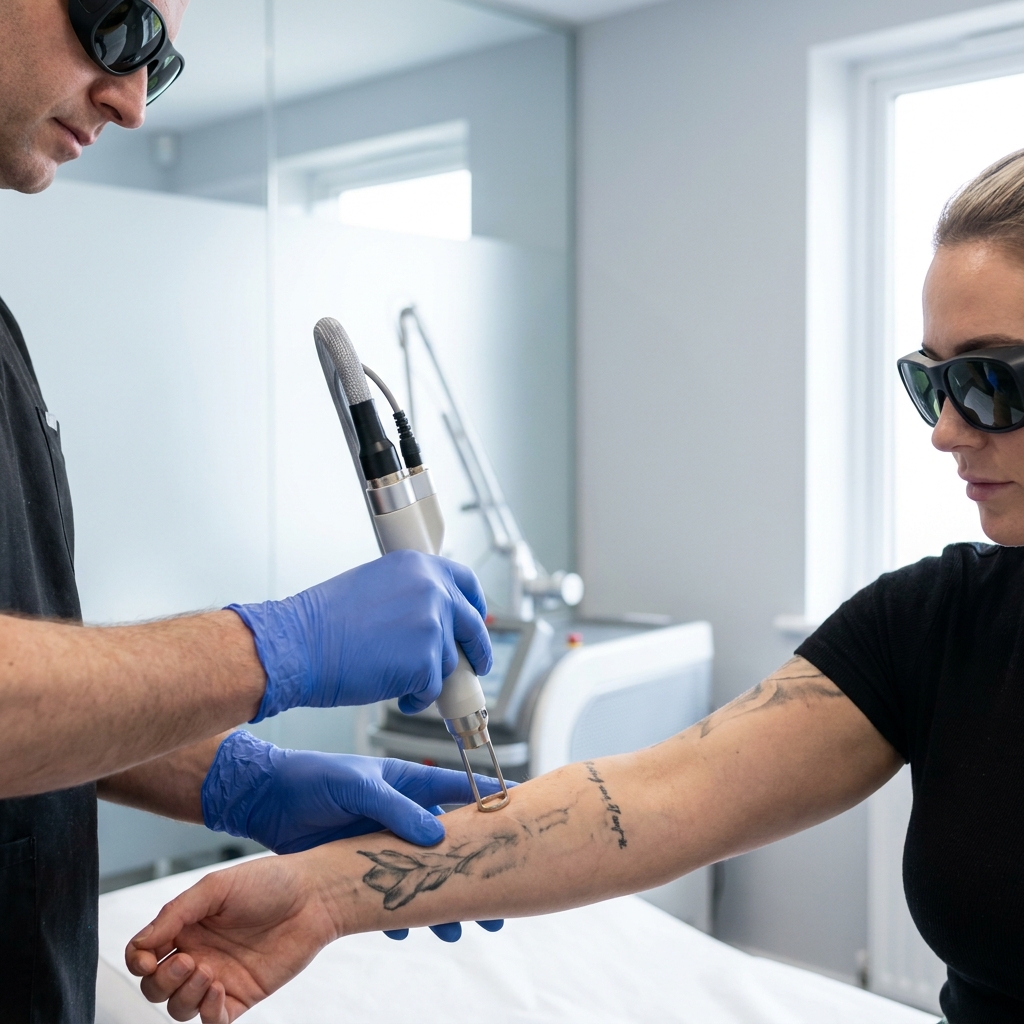
The laser used for partial removal is the same as for full removal — a Q-switched or picosecond device delivering precise pulses of light. The difference is in technique: the practitioner directs the beam only at the area to be cleared, shielding or simply avoiding the ink you want to keep. The fragmented pigment is then cleared by your immune system over the following weeks, exactly as in a full course. Because the laser beam is small and controllable, a skilled practitioner can work surprisingly close to ink you wish to preserve, although there are practical limits. The mechanism is the same as on how tattoo removal works.
When partial removal makes sense
Selective removal suits situations where the unwanted part is reasonably distinct from the rest. Common reasons people ask for it include:
- An ex-partner’s name within a larger design you otherwise like.
- A word or date you want gone while keeping the imagery.
- One element of a composition — a symbol, a small figure, a mistake.
- A specific colour you dislike, where the laser can target that pigment.
- Clearing space for new work without removing the whole piece.
| Scenario | Suitability |
|---|---|
| Isolated name or word | Often well suited |
| Section with clear gap around it | Suitable |
| Detail touching ink you keep | More challenging — needs care |
| Fine linework intertwined | Hardest — precision limits apply |
The challenge of precision
The harder the unwanted ink is to separate from the ink you want to keep, the more demanding the treatment. Where elements are intertwined or very fine, there is a limit to how precisely the laser can isolate them, and some neighbouring ink may be affected. There is also the question of the edge: the boundary where removed ink meets retained ink may end up slightly softened rather than razor-sharp. An experienced practitioner will be honest about what can and cannot be achieved cleanly, which is why choosing a qualified clinic matters — see choosing a clinic and is my removalist qualified.
Will it look obvious afterwards?
A realistic concern with partial removal is whether the finished tattoo will look natural or leave an obvious gap. The answer depends on the design. Removing an isolated name from a wider piece often blends well, while taking out an element from the middle of a tight composition can leave a noticeable space. Many people plan partial removal alongside a tattoo artist, who can rework or extend the remaining design once the unwanted ink has faded, so the two stages work together rather than leaving a hole.
Sessions, cost and next steps
Partial removal still follows the same course principles: multiple sessions spaced 6–8 weeks apart, with the number depending on the ink’s colour, depth and age — see factors affecting tattoo removal. Because the treated area is smaller, the cost per session may be lower than for a full piece, though pricing varies by clinic and some charge a minimum fee regardless of size. If your aim is to lighten a section to take new ink rather than remove it entirely, fewer sessions are usually needed — covered on tattoo removal before cover-up. As with any removal, the same care over skin reactions, aftercare and healing applies, so the area should be looked after between sessions just as it would for a full treatment. This page is general information, not medical advice; a consultation and patch test are essential to plan partial removal safely.
Frequently asked questions
Can a laser remove just one name from a tattoo?
Often, yes, if the name is reasonably separate from ink you want to keep. The practitioner targets only that area. A consultation will confirm how cleanly it can be isolated.
Will the rest of my tattoo be affected?
The aim is to treat only the unwanted ink, but where elements are very close or intertwined, some neighbouring ink may be affected. Your practitioner will explain the likely result first.
Does partial removal cost less than full removal?
Often the per-session cost is lower because the area is smaller, but it still needs a course of sessions. Pricing varies by clinic and the ink involved.
Is partial removal harder than full removal?
It can be, because it demands precision to spare the ink you keep. Intertwined or fine detail is the most challenging, so an experienced practitioner is important.
Sources & further reading
- NHS — Laser and intense pulsed light (IPL) treatments
- MHRA — Lasers, intense light source systems and LEDs: guidance
- NHS — Cosmetic procedures: things to consider before you go ahead
- JCCP — Joint Council for Cosmetic Practitioners patient guidance
This guide is general information, not medical advice. A patch test and consultation with a qualified, regulated practitioner are essential before treatment, and results vary by individual. Discuss any skin or health concerns with the practitioner or your GP.