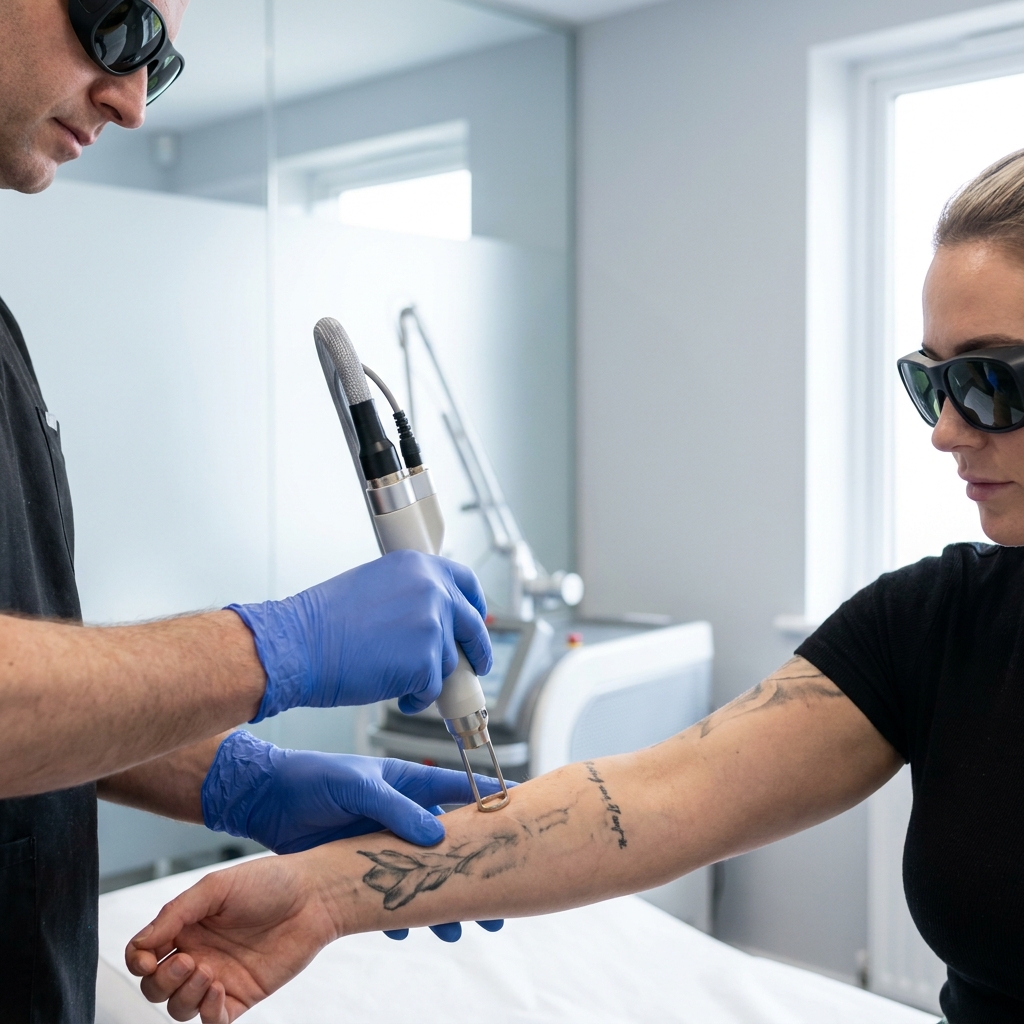
The short answer
Whether removal is worth it depends on how much the tattoo bothers you, set against the cost, the months of treatment and the fact that complete removal cannot be guaranteed. Many people are very satisfied, especially with black ink that fades well. But it is a course of 6–12 sessions over many months, it can be uncomfortable, and some colours or stubborn ink may never disappear entirely. It is a personal judgement, best made after a consultation.
‘Worth it’ is a personal calculation, not a clinical one. The honest answer balances what removal can realistically achieve against its cost, the time commitment and the discomfort involved. This page lays out both sides plainly so you can decide, and points you to the practical detail you need before committing.
The trade-offs at a glance
- Cost Course of £200–£600+ (more for large)
- Time Often 9–18 months
- Sessions Usually 6–12
- Discomfort Real but manageable
- Results Often good, not guaranteed complete
- Best outcome Black ink, healthy skin
What you are weighing up
Deciding whether tattoo removal is worth it means balancing four things: the cost, the time, the discomfort, and the likely result. None can be ignored, and the weight you give each is personal. A small black tattoo you have grown to dislike, or one that affects your work or wellbeing, is a very different proposition from a large multi-colour piece you are merely curious about removing. There is no universal answer — only the one that is right for you, made with realistic information.
- Cost — a course, not a one-off; often £200–£600 for small tattoos and £1,000+ for large ones. See tattoo removal cost.
- Time — 6–12 sessions spaced 6–8 weeks apart means many months of commitment, often 9 to 18 months.
- Discomfort — the procedure is uncomfortable, though usually tolerable and brief; see does it hurt.
- Result — often very good, but complete removal cannot be promised, and results vary by individual.
It can help to ask yourself how often the tattoo actually affects you. If it is a daily source of discomfort, the investment of money and time is easier to justify than for a tattoo you rarely think about. There is no shame in either answer; the point is to be honest with yourself before starting a long course.
The case for
For many people the answer is yes. The established Q-switched and picosecond lasers fade most tattoos significantly, and black ink — the most common — tends to respond best of all. The relief of being free of a tattoo that no longer fits your life, your career or your sense of self can be genuinely worthwhile, and for some it resolves a daily source of self-consciousness. Removal can also lighten a tattoo enough for a cleaner, more flexible cover-up, which some find the best of both worlds — you keep the option of new artwork without the old design showing through. For old, faded or amateur tattoos in particular, a relatively short course can achieve a satisfying result.
The case for caution
Equally, removal is not a quick fix, and it pays to go in clear-eyed. It costs real money over a long period, requires patience through the weeks between sessions, and carries the ordinary risks of any laser treatment — including temporary blistering, swelling, scabbing and, less commonly, changes in skin texture or colour; see side effects. Some colours, particularly green, light blue and yellow, are stubborn and may fade only partially, so expectations must be realistic. If your tattoo is large, dense or colourful, both the cost and the timeline rise sharply, as our sleeve removal guide shows.
| For | Against |
|---|---|
| Often fades tattoos substantially | Cannot guarantee complete removal |
| Black ink responds well | Some colours remain stubborn |
| Can enable a better cover-up | Course costs and months of time add up |
| Established, regulated technology | Temporary discomfort and side-effect risk |
How to decide well
Book a consultation with a qualified, regulated practitioner before deciding. They can assess your ink, skin tone and likely response, give a realistic estimate of sessions and cost, and carry out a patch test to check how your skin reacts. Use that honest picture — not a marketing promise — to weigh the trade-offs against how much the tattoo genuinely bothers you. If budget is the sticking point, read tattoo removal financing for the options and the cautions, and consider whether partial removal or lightening might meet your goal more cheaply. This page is general information, not medical advice; the right decision is yours to make, with professional input.
Frequently asked questions
Is tattoo removal worth the money?
For many people, yes — especially for black ink that fades well. But it is a course costing hundreds or more, and results vary, so weigh the cost against how much the tattoo bothers you.
Will my tattoo definitely come off?
Not guaranteed. Many tattoos fade dramatically, but some pigment, particularly certain colours, may remain. A practitioner will give an honest, individual assessment at consultation.
Is it worth it if I just want a cover-up?
Possibly. Lightening a tattoo with a few laser sessions can make a cover-up cleaner and more flexible. A tattoo artist and a removal practitioner can advise on the best approach.
How long before I see it’s worth it?
Fading is gradual across many months. You will usually see meaningful change over several sessions, but patience is essential and the full result comes only at the end of the course.
Sources & further reading
- NHS — Cosmetic procedures: laser and light treatments, risks and considerations
- MHRA — Lasers and IPL: information for the public and providers
- BMLA — British Medical Laser Association guidance on laser treatment expectations
- JCCP — advice on choosing a practitioner and realistic outcomes
This guide is general information, not medical advice. A patch test and consultation with a qualified, regulated practitioner are essential before treatment, and results vary by individual. Discuss any skin or health concerns with the practitioner or your GP.